



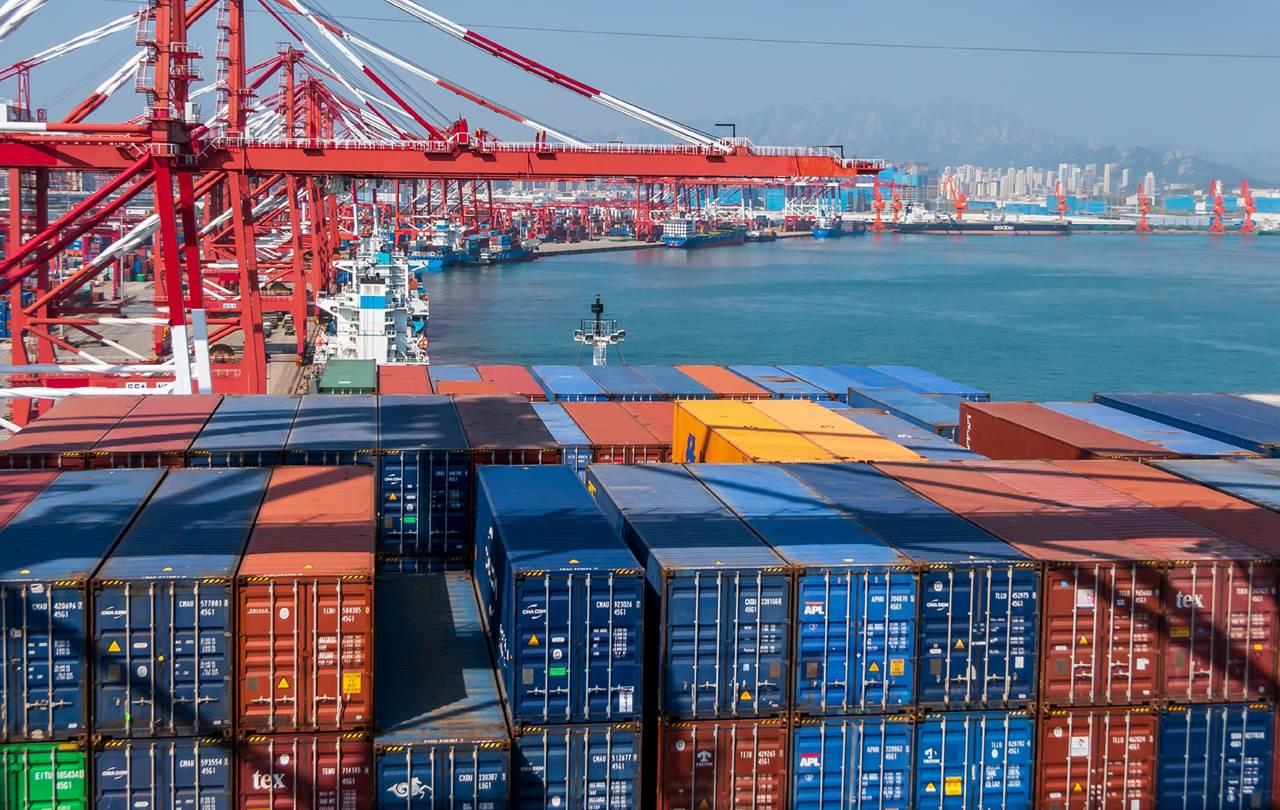
For textile and apparel supply chains, 2025 has been a year caught between crisis and normalisation. Ocean routes remained (and continue to remain) distorted by war and political risk: container ships that once routinely used the Suez Canal now often sail the long way around the Cape of Good Hope to avoid conflict around the Red Sea. Transit times are longer, schedules more fragile, and the threat of sudden disruption hangs over every shipment.
At the same time, freight markets look surprisingly soft. Spot rates on major routes such as Asia–US have fallen sharply from their mid-2024 peaks, even as ships still make costly detours. New vessel capacity ordered during the pandemic boom continues to enter service, creating a buyers’ market for many shippers. The result is a strange dual reality: geopolitics are tense, but logistics systems are functioning; routes are longer, but costs are often lower.
For the global textile and apparel sector, 2025 is therefore not a story of total breakdown. Rather, it is a stress test of how well brands, manufacturers, carriers, and financial partners can adapt to persistent volatility—keeping garments moving in a world where chokepoints, labour relations, and trade policy all matter as much as fashion trends.
A Year Framed by Geopolitics and War
The defining shock to 2025 apparel logistics is the ongoing Red Sea crisis. Since late 2023, Yemen’s Houthi movement has targeted commercial shipping in the Red Sea and Bab al-Mandeb Strait, in the context of the Israel–Gaza conflict. Through 2024 and into 2025, several ships were sunk or damaged and multiple seafarers killed, turning one of the world’s key trade corridors into a high-risk zone.
The knock-on effects on the Suez Canal were significant. Normally, the canal handles roughly a trillion dollars in trade annually; attacks and insurance premiums forced many carriers to divert around the Cape of Good Hope, cutting Suez revenues and adding 7–14 days to typical Asia–Europe voyages. For apparel supply chains—from South Asia, China, and Southeast Asia into Europe—this meant a structural increase in lead times.
Early 2025 brought cautious optimism but no clear resolution. Houthi leaders signalled a conditional pause in attacks tied to ceasefire progress in Gaza, but shipping lines and insurers were unconvinced that the corridor had become reliably safe. The Red Sea remained categorised as a war zone by many underwriters, and vessel operators were reluctant to bet their crews and cargo on a fragile truce.
Carriers adopted differing strategies that shaped apparel logistics:
- Maersk publicly committed to avoiding the Red Sea “well into 2025,” maintaining full rerouting around the Cape of Good Hope until it judged the risk acceptable.
- MSC, the world’s largest container line, pursued a similarly conservative approach, prioritising schedule reliability and crew safety over shorter routes.
- CMA CGM took a more experimental path, cautiously sending a small number of ships back through the Suez Canal under naval escort in late 2025 to test whether protected transits could be viable.
Even with these tentative steps, the industry treated Suez as only partially available at best. The Red Sea crisis thus remained the geopolitical frame for 2025: a single chokepoint whose instability reshaped transit times, network design, and the risk calculus for textile and apparel logistics.
Timeline of 2025: Smooth Sailing vs. Snarls
Early 2025 (Q1): Slow but Stable
The first quarter of 2025 combined prolonged detours with an important “near miss” in US ports.
- Red Sea still off-limits: Most carriers continued to divert Asia–Europe services around the Cape, locking in longer, more expensive voyages. Importers responded by shipping earlier, carrying more buffer stock, and treating extended transit times as the new normal.
- US dockworkers’ strike averted: On the other hand, a major potential disruption never materialised. East and Gulf Coast US ports faced the risk of a large-scale dockworkers’ strike in mid-January. A last-minute deal between the International Longshoremen’s Association and port employers avoided shutdowns at key gateways from New York/New Jersey to Houston.
With that agreement in place, apparel flows into North America were relatively smooth in Q1. The picture for Asia–Europe was slower but predictable: longer voyages, but no sudden blockages.
Spring to Mid-Year (Q2–Q3): Adjustment and Local Friction
By spring, logistics challenges were less about new shocks and more about adapting to a reconfigured baseline.
- Persistent Cape detours: Even as diplomatic efforts sought to calm the Red Sea, most Asia–Europe container services stayed on the longer route. Transit times to North Europe stretched in many cases to six weeks or more, complicating calendar planning for fast-fashion brands that rely on rapid replenishment.
- European port disruptions: Local labour actions and infrastructure bottlenecks created pockets of congestion at ports such as Antwerp, Rotterdam, Hamburg and some Mediterranean hubs. These strikes and protests added a few days of delay here and there, but did not paralyse the system.
- More ships, fuller pipelines: The big counterbalance to these delays was capacity. A wave of new container vessels entered service, and carriers redeployed tonnage to maintain weekly sailings despite longer round-trip times. By adding more ships to schedules, they “stretched” their networks while keeping cargo flowing.
Data during this period showed an important trend: despite longer routes and periodic strikes, freight rates on Asia–Europe lanes actually declined compared with 2024. Spot prices fell as new capacity outpaced demand. By late summer, some indices showed Asia–North Europe rates down by around 60 per cent year-on-year, even though ships were still detouring around Africa. The industry had, in effect, normalised operations around the Red Sea disruption.
April to August 2025 thus looked like a period of manageable friction: extended lead times, localised congestion, but no global meltdown.
Late 2025 (Q3–Q4): Volume Growth and Rate Volatility
By the third quarter, container volumes in global trade were growing again, including for apparel.
- Demand returning: Worldwide container demand posted mid-single-digit year-on-year growth. Imports into Europe, Africa, and Latin America picked up, offsetting softness on some US lanes. Consumers continued to spend on clothing, ensuring steady flows of garments despite the detours.
- Trans-Pacific rates slump then spike: On Asia–US routes, oversupply and uneven import growth pushed rates down through mid-2025. West Coast spot prices, which peaked in early June 2025, had fallen to less than half that level by late August. Then, on November 1, Trans-Pacific carriers including CMA CGM, COSCO, Evergreen, Hapag-Lloyd, HMM, ONE, Yang Ming and ZIM imposed a GRI (General Rate Increase), causing a brief spike in spot rates before weak demand eroded the increase.
Operationally, however, the end of 2025 was relatively calm: no large-scale port shutdowns, a quieter Red Sea under ceasefire conditions, and reasonably reliable schedules. The key challenge for apparel logistics teams was managing cost swings and timing rather than dealing with crisis-level disruption.
Looking back, the rhythm of the year was uneven but survivable:
- • Q1: slower but more stable than feared, thanks to the averted US strike.
- • Q2–Q3: persistent detours and scattered European labour issues, offset by more ships and falling rates.
- • Q4: localised snarls and price volatility, but no systemic breakdown.
Shipping Lifelines: Asia–US and Asia–Europe Under Strain
Two long-haul corridors remained central to apparel logistics in 2025: Asia–US and Asia–Europe/Mediterranean. Each faced distinct pressures.
Asia–US (Trans-Pacific)
The trans-Pacific corridor—linking factories in China, Vietnam, Bangladesh and others to North American retailers— was defined in 2025 by excess capacity and price competition.
- New ships vs. soft demand: Large numbers of vessels ordered during the 2021 crunch entered service just as US import growth cooled. Retailers, wary after pandemic over-stocking, were more cautious with orders. Tariff uncertainty and shifting sourcing from China to Southeast Asia and near-shore locations also reshaped volumes.
- Declining spot rates: With supply outpacing demand, spot prices from Asia to the US West Coast fell to roughly $1,500–2,000 per forty-foot container by mid-year, dramatically lower than 2024 levels. East Coast rates, normally higher due to longer routes, also dropped.
- Trade tensions and tariff noise: The new Section 301 port-entry fees on Chinese-owned, operated, and built vessels took effect on October 14, 2025, but collection was suspended from November 10, 2025 for one year under a US–China understanding, even as Beijing responded with its own retaliatory port fees on US-linked ships.
Shippers used this environment to renegotiate contracts, blend contract and spot exposure, and split volumes between West and East Coast ports based on changing price and transit time trade-offs. Some experimented with different Incoterms (international commercial terms), shifting more responsibility for freight onto suppliers or logistics partners to gain flexibility and risk-sharing.
Operationally, US ports performed relatively well:
- West Coast gateways had resolved earlier labour disputes and worked efficiently.
- East and Gulf Coast ports continued to benefit from the January labour settlement.
- Drought-related constraints at the Panama Canal occasionally forced adjustments but did not substantially derail flows.
Carriers attempted to reverse rate declines with GRIs (General Rate Increases) and blank sailings in the fall. For apparel importers, the trans-Pacific in 2025 was less about congestion and more about contract strategy, routing choices, and timing shipments around price spikes.
Asia–Europe & Mediterranean
For Asia–Europe apparel flows, 2025 was dominated by the loss of routine access to Suez Canal and the industry’s adjustment to Cape of Good Hope detours.
- Longer voyages as standard: Transit times from South Asia or East Asia to North Europe often exceeded 40 days via the Cape, compared with 25–30 days via Suez. This put pressure on fast-fashion models, where a delay of even ten days can mean missing a season’s peak.
- Selective use of air and rail: For high-value or time-critical items, some brands increased use of air freight or China–Europe rail, accepting higher cost to protect sales windows. The bulk of volume, though, continued to move by sea.
Despite longer distances, Asia–Europe freight rates fell as the expanded global fleet chased limited cargo. For apparel buyers in Europe, this produced a mixed picture: cheaper shipping but structurally longer lead times.
Some retailers and brands responded by:
- Extending design-to-shelf calendars and ordering earlier.
- Diversifying sourcing to nearer regions such as Türkiye, Eastern Europe, and North Africa.
- Splitting production portfolios so a portion of basics and replenishment items came from locations closer to market.
The Asia–Europe lifeline in 2025, then, was not broken but reconfigured—slower, more complex, and less dependent on a single canal.
Overcoming Hiccups: Finance, Shipping and Creative Logistics
Financial Band-Aids and Trade Finance
Longer and less predictable transit times strain the working capital of textile and apparel exporters. Therefore, in 2025, financial tools became more important in keeping factories running and orders flowing. Key mechanisms included:
- Letters of credit and export credit insurance to guarantee payment despite delays.
- Supply chain finance, allowing suppliers to get paid early by banks while buyers kept longer payment terms to account for extended transit.
- Receivables financing and extended terms, smoothing cash flow when a 30-day shipment became a 50-day one.
- Currency and interest-rate hedging, as volatile macro conditions added financial risk to already stretched logistics.
Behind the visible movement of containers, banks and fintech platforms played a quiet but crucial role in cushioning the financial impact of disrupted timelines.
Shipping and Logistics Interventions
Carriers and logistics providers also adapted their operations and customer communication.
- Transparent advisories: Lines like Maersk regularly published updates on rerouting and revised transit times, helping apparel shippers adjust production and inventory plans.
- Network redesign: Carriers inserted extra vessels, adjusted port rotations, and sometimes levied surcharges to cover Cape detours while maintaining service frequency.
- Forwarder creativity: Freight forwarders and 3PLs (third-party logistics providers) orchestrated alternative routings when particular ports or corridors became bottlenecks—diverting vessels to less congested ports, arranging overland trucking within Europe, or building contingency plans around possible labour actions.
Technology amplified these efforts. Real-time tracking, exception alerts, and route-optimisation tools allowed logistics teams to respond quickly when a vessel was diverted or delayed, reducing the element of surprise.
Resilience Tactics by Apparel Producers and Brands
At the production end, manufacturers and brands deployed multiple tactics to manage risk.
- Re-routing inputs: Jordan’s garment industry, heavily dependent on Red Sea access, offers an extreme example. With standard routes disrupted, many factories shifted fabric and trim imports via Gulf ports such as Jebel Ali and then trucked materials overland through Saudi Arabia—adding cost and complexity but keeping lines running.
- Buffer stocks and longer lead times: Many Asian manufacturers increased stocks of yarns, fabrics, and trims; brands extended order lead times by several weeks to absorb shipping uncertainty.
- Multi-mode hedging: Some companies routinely sent a portion of each collection by air as “insurance,” ensuring at least part of the assortment arrived on schedule if ships were delayed.
- Incremental nearshoring and friend-shoring: Retailers and brand groups began placing more orders with suppliers in Central America, the Balkans, North Africa, and other nearer or politically aligned regions. These moves did not replace Asia but provided diversification and reduced exposure to single chokepoints.
Information-sharing also improved. Trade associations, industry groups, and logistics partners circulated guidance on alternative routes, risk management, and scenario planning. By late 2025, the sector had built a much richer playbook for dealing with geopolitical shocks than it had just a few years earlier.
Lessons Learned and the Road Ahead
The logistics experiences of 2025 have crystallised several strategic lessons for the textile and apparel industry.
1. The Limits of Pure Just-in-Time
The Red Sea and Suez disruptions showed how quickly lean, just-in-time models can falter when a single corridor fails. Many companies are moving towards hybrid strategies that blend efficiency with resilience: more safety stock on critical items, multiple suppliers, and built-in lead-time buffers.
2. Multi-Route and Multi-Modal as Standard Practice
The year reinforced a simple rule: do not rely on a single route, port, or carrier. Going forward, more brands will:
- Split volumes across different canals, coasts, and ports.
- Keep backup options for rail and air.
- Use digital tools to model disruptions and identify rerouting options in near real time.
Resilience is becoming a design principle of network architecture, not an after-the-fact improvisation.
3. Diversified and ‘Friend-Shored’ Sourcing
Geopolitics now shape sourcing as much as labour costs do. While Asia will remain the core of apparel manufacturing, companies are clearly aiming for more diversified portfolios—balancing large hubs like China and Bangladesh with production in countries seen as more politically stable, closer to key markets, or linked by favourable trade agreements.
4. Flexible Contracting and Deeper Collaboration
Rigid contracts often proved unhelpful when shipping networks changed overnight. In response, shippers and carriers are moving towards more flexible agreements, allowing for volume shifts, route changes, and adjusted delivery windows without punitive penalties.
Trust and information-sharing have become competitive advantages: brands are sharing better forecasts; carriers and logistics providers are offering more integrated, end-to-end solutions. The mindset is shifting from “lowest price at any cost” to “best mix of cost, reliability, and adaptability.”
5. Technology, Visibility, and Predictive Analytics
Companies that invested in visibility platforms, data integration, and early-warning systems navigated 2025’s volatility more smoothly. The future points towards:
- Automated alerts when vessels divert or political risks spike.
- Systems that recommend alternate routes or modes dynamically.
- Inventory and replenishment algorithms that respond to live logistics data rather than static assumptions.
Data-driven agility is becoming a core capability of successful apparel supply chains.
 marketing@alchempro.com