



Amid heightened geopolitical fragmentation, climate risk and supply-chain recalibration, the rules of economic competitiveness are being quietly rewritten. The global production landscape is shifting in ways that will reshape how countries trade and grow. Protectionist policies, supply-chain disruptions, climate-related volatility and new compliance-driven regulations are steadily altering the terms of international commerce. Market access is no longer determined only by cost or scale, but by sustainability, traceability, and risk exposure embedded across supply chains.
In major economies, frameworks such as deforestation regulations, carbon border adjustments and mandatory due-diligence requirements are becoming central to trade and investment decisions. For emerging economies, the capacity to respond to these regulatory and market shifts will increasingly define long-term competitiveness and economic resilience.
India stands at a critical juncture where decisions made today will shape its economic resilience and competitiveness for years to come. One of the most compelling yet still underleveraged opportunities lies in advancing next-generation fibres derived from agricultural residues and textile waste for use in paper, packaging, and textiles. The technologies required are already proven; what has changed is their strategic significance. As global markets place greater emphasis on low-carbon sourcing, forest protection, and regulatory compliance, countries that can supply sustainable, traceable materials will hold a clear advantage. In this context, developing commercially viable alternatives to conventional fibre is no longer optional; it is central to securing long-term market access and growth.
Organising India’s Dispersed Residue into a Reliable Industrial Base
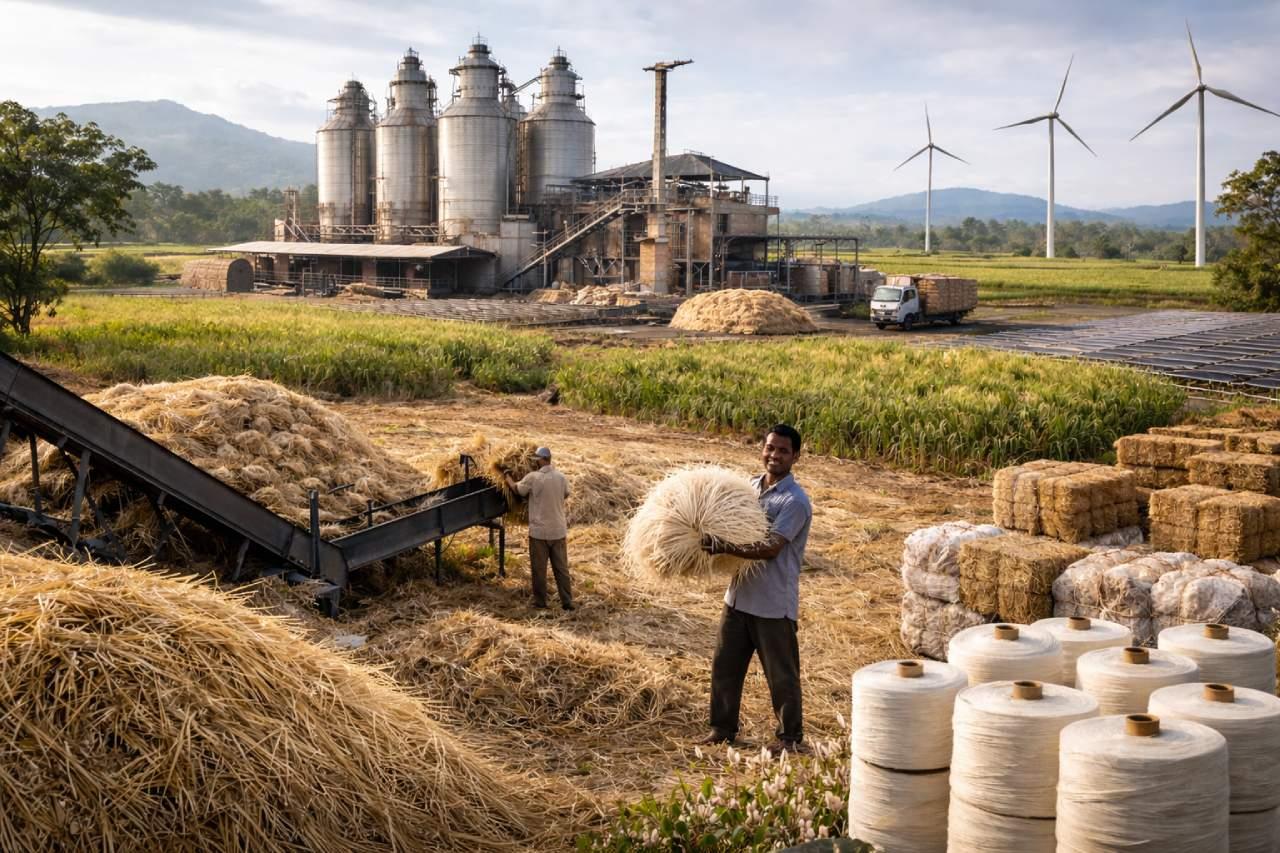
India generates large volumes of agricultural residue and post-consumer textile waste each year. Much of this material is either burned or discarded, contributing to air pollution, resource inefficiency and economic loss. Redirecting even a portion of these residues towards industrial use would provide a domestic fibre source, reduce import dependence and create more stable input streams for manufacturers. It would also position Indian producers to meet tightening sustainability and traceability requirements in export markets where material provenance is becoming non-negotiable.
This potential remains largely under-realised not only because the material is dispersed across millions of small farms and informal waste channels, but also because policy frameworks are not yet designed to encourage circular material use. India has made progress in supporting biofuel pathways, and an estimated eight million tonnes of rice straw are already being collected for that sector each year. However, comparable structures that channel residue towards fibre-based circular industries are still limited. The absence of dedicated aggregation, storage and logistics systems for material recovery continues to constrain consistency and scale. States such as Punjab, Haryana, Uttar Pradesh, Gujarat and Tamil Nadu combine agricultural output with industrial capability, creating favourable conditions for a structured supply chain. What is missing is coordinated, system-level execution and policy alignment that can convert residue abundance into reliable industrial feedstock for circular fibre production.
Capital Requirements That Exceed Conventional Investment Appetite
Financial architecture will be equally decisive. Estimates suggest that building a commercially viable Next Gen fibre ecosystem could require $13 to $15 billion in investment by 2033. This includes processing facilities, logistics networks, storage infrastructure and technologies capable of handling variable feedstock quality. These early-stage investments often fall outside the risk appetite of conventional private capital, particularly when returns depend on the maturation of entirely new supply chains.
Globally, blended finance has emerged as a practical response to such challenges. By combining public funding, development finance and philanthropic capital, this approach reduces the risk for private investors while accelerating adoption in sectors where demand exists but enabling infrastructure lags. As climate-aligned and circular-economy investments gain momentum, structured risk-sharing mechanisms are becoming central to industrial transition strategies. For India, such financial models could be instrumental in scaling the Next Gen fibre sector beyond isolated pilots into a durable industrial ecosystem.
Credibility, Verification and the New Terms of Market Access
Governance frameworks will shape outcomes as decisively as capital. As global buyers face growing scrutiny over emissions, labour standards and deforestation exposure, reliance on verified data has replaced reliance on intent or declarations. Transparent systems for traceability, sustainability performance and quality assurance are no longer optional. They are pre-requisites for participation in premium and regulated markets.
India’s experience with digital public infrastructure demonstrates its capacity to build trusted, scalable verification systems. Applying similar institutional rigour to circular material supply chains could enable Indian producers to meet international expectations while building long-term market confidence. Beyond environmental performance, the ability to demonstrate consistent quality and ethical sourcing will determine global acceptance. Countries that embed credibility early will help shape emerging norms rather than adapt to them later.
Positioning India for an Economy Shaped by Sustainability Benchmarks
The strategic appeal of a Next Gen fibre industry lies in its alignment with multiple national priorities. It offers a pathway to reduce stubble burning, support rural livelihoods, expand green manufacturing and respond to global sustainability benchmarks without constraining growth. At a time when global forums increasingly emphasise resilient, low-carbon and transparent supply chains, India has an opportunity to position itself as a reliable supplier of sustainable materials.
Whether this opportunity is realised will depend on the speed at which enabling infrastructure, financial mechanisms and governance frameworks are established. Markets are already moving decisively towards materials that minimise environmental risk and offer credible traceability. For India, engaging with this shift is less about signalling ambition and more about strategic necessity. The choice is between shaping emerging markets early or adjusting later once the terms are firmly set.
 marketing@alchempro.com