



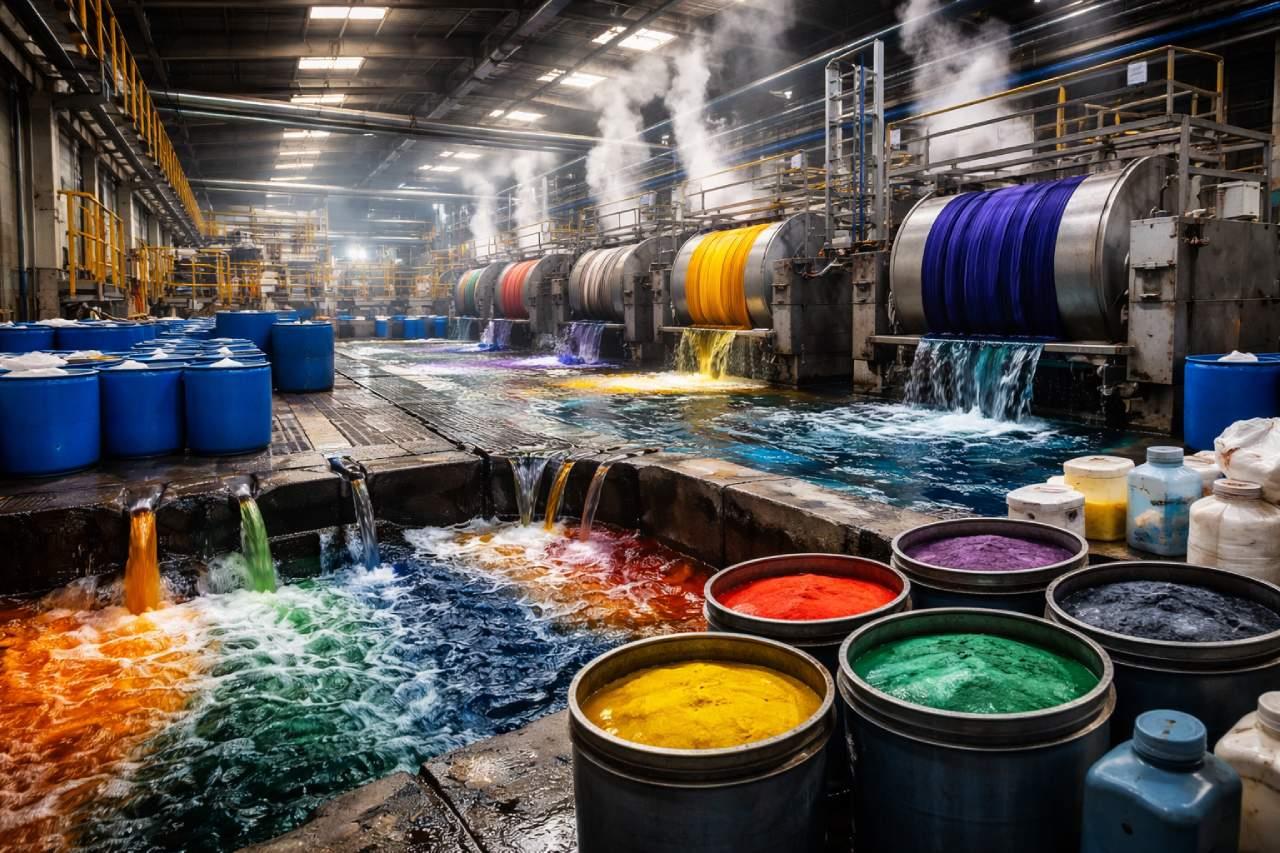
In textile dyehouses, wastewater pollution is largely determined by how much dye fails to fix onto the fibre and by the volume and type of auxiliary chemicals required to complete the dyeing cycle. In real production environments, theoretical fixation values rarely match actual performance due to variations in liquor ratio, temperature control, dosing accuracy, shade depth and machine type.
In practice, the pollution load can be simplified as:
Wastewater load = Unfixed dye fraction + auxiliary chemical residue + process losses
Field audits consistently show that darker shades, high liquor ratios and poor washing efficiency significantly amplify environmental impact. Therefore, dye class alone does not define pollution; operational discipline plays an equally important role.
Main Sources of Wastewater Pollution
Textile dyehouse effluent is a complex mixture. The primary contributors include:
- Unfixed or hydrolysed dye molecules
- Electrolytes (salt, Glauber’s salt, sodium sulphate)
- Alkalis and acids used for pH control
- Reducing and oxidising agents
- Soaping agents and detergents
- Dispersing agents and levelling chemicals
- Heavy metals (in specific dye types)
The contribution of each factor varies significantly by fibre type and dye class.
Reactive Dyes (Cotton – High Pollution Load)
Reactive dyes are widely used for cotton due to their brightness and wash fastness. However, they are one of the largest contributors to dyehouse effluent load.
Typical industrial fixation efficiency ranges between 60–70 per cent under standard bulk conditions. This means 30–40 per cent of dye hydrolyses and cannot react with the fibre. That hydrolysed portion is discharged during washing-off.
In addition, reactive dyeing requires:
- Large quantities of salt (40–100 g/L depending on depth)
- Alkali for fixation
- Multiple hot washes for removal of hydrolysed dye
Problematic shades in practice include:
- Black
- Dark navy
- Deep red
- Heavy builds above 4 per cent shade
Typical effluent observations:
- Brownish-yellow wastewater after neutralisation
- Chemical Oxygen Demand (COD) levels between 3000–6000 mg/L
- Total Dissolved Solids (TDS) often extremely high due to salt load
In many ETPs (effluent treatment plants), salt becomes a more persistent issue than colour removal itself.
Disperse Dyes (Polyester)
Disperse dyes are water-insoluble and applied as fine dispersions. Dye fixation to polyester is relatively high under controlled temperature conditions.
Direct dye loss is lower than reactive systems. However, pollution increases significantly during post-dyeing reduction clearing.
Main pollution sources include:
- Sodium hydrosulphite
- Caustic soda
- Dispersing agents
- Soaping agents
Field measurements typically show:
- COD: 800–1500 mg/L
- Moderate colour load
- Higher sludge generation due to dispersant residues
Poor reduction control can sharply increase COD spikes.
Acid and Metal Complex Dyes (Polyamide/Wool)
This dye class demonstrates the most stable environmental performance when properly managed.
Metal complex dyes often achieve fixation efficiencies above 90 per cent. Unfixed dye fractions generally remain below 10 per cent.
Operating in mildly acidic conditions (pH 4.5–5.5) reduces the need for heavy alkali dosing. Electrolyte use is minimal compared to reactive systems.
Typical effluent characteristics:
- COD: 200–600 mg/L
- Low residual colour
- Stable pH profile
- Limited auxiliary residue
However, in some cases, chromium-containing metal complex dyes may raise heavy metal compliance concerns if not controlled.
Direct Dyes (Cotton – Among the Most Polluting Classes)
Direct dyes have weak fibre affinity and rely heavily on electrolytes for exhaustion.
Large quantities of salt are required, and fixation remains limited. As a result, a significant portion of dye remains unfixed.
Black direct dyes are especially problematic, often generating:
- Very high COD
- Elevated colour intensity
- Increased Adsorbable Organic Halides (AOX) levels (in some formulations)
Typical field COD levels:
- 4000–8000 mg/L
- In deep shades, even higher than reactive dyeing
Because washing efficiency is often limited in bulk production, direct dyeing can be environmentally severe.
Sulphur Dyes (Cotton – Heavy Pollution Load)
Sulphur dyes are reduced to a soluble form before application. After oxidation on the fibre, residual sulphide compounds and unfixed dye enter wastewater.
Common field issues include:
- High COD
- Strong black effluent colour
- Elevated sulphide concentration
- Odour issues
Operational risks observed:
- Black sludge formation in clarifiers
- Pipeline corrosion due to sulphide
- Toxicity concerns in biological treatment units
Poor oxidation control worsens pollution dramatically.
Vat Dyes (Indigo – Denim Sector)
Vat dyes such as indigo are reduced in alkaline medium and re-oxidised on fibre. However, loosely attached insoluble dye particles often wash off.
Typical characteristics:
- Moderate COD
- High visible colour in discharge
- Significant suspended solids
In denim dyeing, repeated dip–oxidation cycles increase cumulative wastewater volume. Even if COD remains moderate, visual pollution is significant.
Comparative Ranking of Dye Classes by Wastewater Load
Based on field observations in bulk production:
Highest to lowest typical impact:
- Direct dyes
- Reactive dyes
- Sulphur dyes
- Disperse dyes
- Vat (Indigo) dyes
- Acid/metal complex dyes
This ranking may vary depending on:
- Shade depth
- Liquor ratio
- Machine technology
- ETP efficiency
- Water reuse systems
 marketing@alchempro.com