



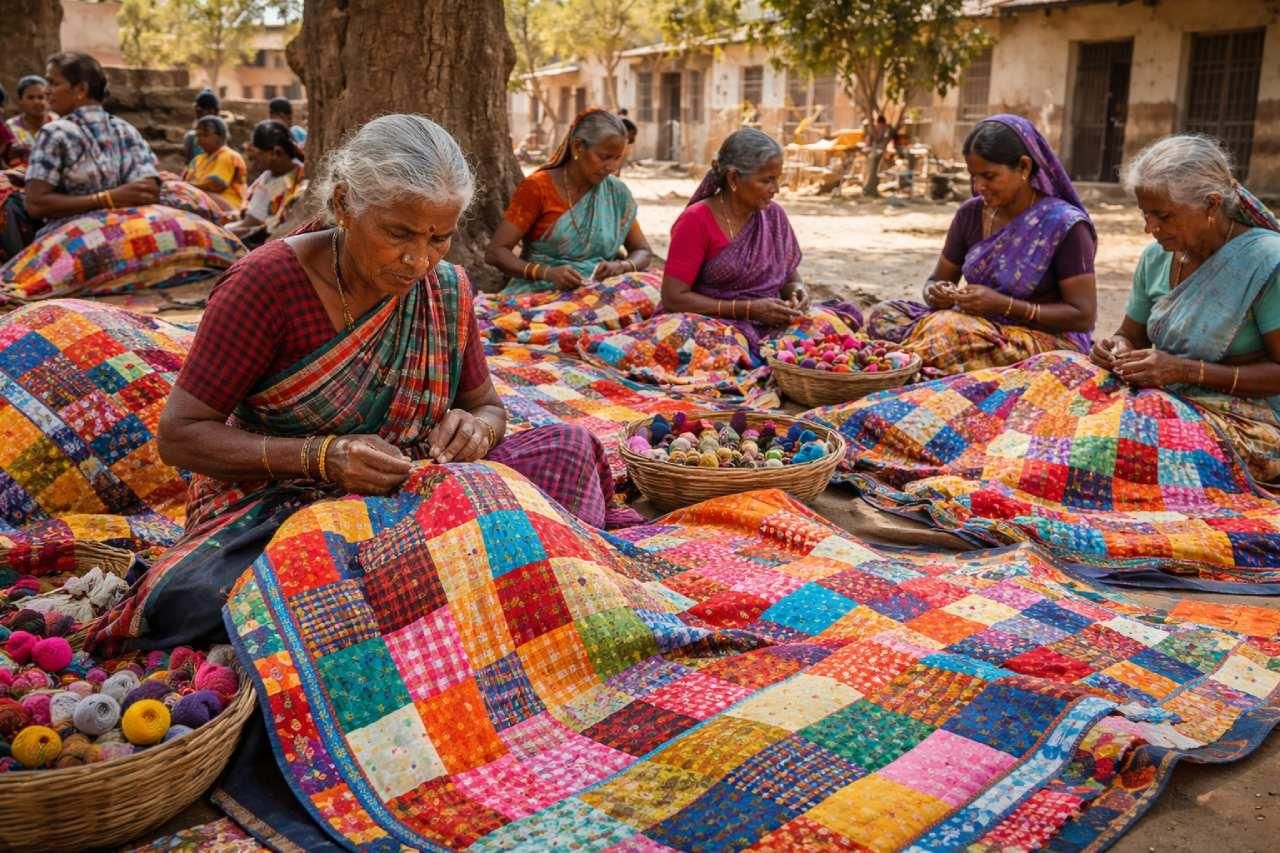
Kaudi, also referred to as Kawandi or Kowdhi, is a traditional patchwork and hand stitched textile practice rooted in the rural communities of Northern Karnataka. Practiced predominantly by women, Kaudi represents an indigenous form of recycled textile craftsmanship that combines functional utility with storytelling, memory, and community expression. Often described as a ‘grandmothers’ art’, the tradition reflects intergenerational transmission of skills, values, and cultural narratives within domestic spaces. Despite its cultural richness and inherent sustainability, Kaudi today is considered an endangered craft, challenged by declining practitioner numbers, limited market visibility, and reduced interest among younger generations. In recent years, however, revival efforts through design restructuring, skill development programmes, and value-added product development have attempted to reposition Kaudi within contemporary craft and eco-design markets.
Historical Origins and Cultural Context
Kaudi is recognised in existing literature as one of the oldest folk textile practices of Northern Karnataka. Its identification underscores its strong association with older rural women and household-based production rather than organised workshops or guild systems. The craft historically evolved within village domestic life, where women reused worn or discarded cloth to create layered textiles for everyday use. Through this process, Kaudi became both a practical household object and a medium of creative expression. While the geographic roots of Kaudi are clearly located in Northern Karnataka, precise historical timelines or origin dates are not documented in the available sources. As such, definitive claims regarding its temporal beginnings cannot be substantiated. Nevertheless, the longevity of the practice is implied through oral transmission, generational continuity, and its deep embedding in rural women’s lives. The absence of written historical records reflects a broader challenge in documenting women-centric folk traditions that have traditionally existed outside formal archival systems.
Craftsmanship and Techniques
At the core of Kaudi craftsmanship is the principle of reuse. Old garments and reclaimed cloth pieces form the primary raw materials, emphasising frugality, sustainability, and resourcefulness. These cloth swatches are assembled into larger textile surfaces through patchwork techniques, which are then stabilised and embellished using dense hand stitching. The visual identity of Kaudi emerges from the layered construction and the extensive network of stitches that bind the fabric pieces together. The technique is characterised by thousands of hand stitches covering the entire surface, giving Kaudi its distinctive textured appearance. These stitches are not merely structural but also narrative, forming motifs and patterns that reflect folklore, lived experiences, and personal expression. However, the specific nomenclature of stitch types such as whether they align with known stitches like running stitch or regional embroidery styles is not clearly documented in the available abstracts. Similarly, technical details regarding thread materials, fibre specifications, stitch counts, or finishing processes are absent, making precise technical classification difficult. These gaps highlight the need for detailed ethnographic and technical documentation of Kaudi practices.
Design, Motifs, and Colour Usage
Kaudi textiles are visually dense and expressive, with stitching patterns often interpreted as narrative devices. The act of stitching itself becomes a form of storytelling, allowing women to encode memories, folklore, and symbolic references into the textile surface. This narrative dimension contributes significantly to the cultural value of Kaudi, positioning it as a medium of intangible heritage as much as a material artifact. Despite this narrative richness, systematic documentation of motif lexicons or symbolic interpretations specific to Kaudi is not available in the provided literature. Similarly, there is no clear evidence outlining colour symbolism unique to Kaudi traditions. While broader Indian textile practices often draw inspiration from nature, rituals, and cultural contexts, Kaudi specific colour meanings cannot be conclusively asserted based on existing sources. The lack of formal motif and colour documentation underscores a significant research gap in understanding Kaudi’s semiotic dimensions.
Socioeconomic Role and Community Significance
Kaudi has traditionally functioned as a women’s household craft, produced primarily for domestic use rather than commercial exchange. Its association with older rural women reinforces its role within familial and community structures, where skills are passed informally from one generation to the next. In contemporary discourse, however, Kaudi is increasingly framed as a potential livelihood option and a tool for women’s economic empowerment. Studies on Kaudi revival emphasise its suitability for micro enterprise development due to low capital requirements, locally available materials, and existing skill bases among rural women. Training programmes and design interventions have positioned Kaudi as a viable income-generation activity, particularly within the context of sustainable and ethical craft markets. Pilot initiatives converting Kaudi into value-added home-textile products such as quilts, mats, and yoga accessories have reported favourable consumer responses, suggesting market potential when traditional aesthetics are adapted for contemporary use. However, quantitative data on income levels, average earnings, or long-term economic impact on artisan households is not provided in the available sources. As a result, claims regarding Kaudi’s economic viability remain indicative rather than empirically substantiated.
Market Dynamics, Decline, and Threats
The decline of Kaudi is attributed to multiple interrelated factors. Reduced commercial relevance, lack of structured market access, and waning interest among younger generations have contributed significantly to the erosion of the practice. As rural lifestyles change and younger women seek alternative livelihoods, traditional crafts like Kaudi face challenges in sustaining practitioner continuity. Structural constraints common to the broader artisanal sector such as limited exposure to markets, inadequate design innovation, and lack of institutional support also affect Kaudi artisans. Without consistent demand or fair remuneration, the incentive to continue practicing this labour-intensive craft diminishes. These challenges underscore the fragile position of Kaudi within contemporary rural economies.
Contemporary Interventions and Revival Efforts
In response to its endangered status, several revival initiatives have been undertaken to document, restructure, and promote Kaudi. These interventions focus on skill development, historical documentation, and design innovation aimed at enhancing marketability. Training programs have introduced artisans to new product categories and quality standards while retaining the core principles of hand stitching and recycled material use. Product diversification has played a central role in revival strategies. Transforming Kaudi into contemporary home-textile products such as yoga mats and lifestyle accessories has helped reposition the craft within eco-conscious and urban consumer segments. The sustainability narrative, rooted in Kaudi’s use of recycled textiles, aligns well with current global interest in slow fashion and circular design practices.
Cultural Meaning and Contemporary Relevance
Beyond its material form, Kaudi holds significant cultural meaning as a medium of storytelling, memory, and women’s creative agency. The dense stitched surfaces act as repositories of personal and collective narratives, reinforcing community bonds and cultural continuity. The label ‘grandmothers’ art’ itself conveys respect, heritage, and emotional resonance, even though direct ethnographic testimonies from practitioners are not included in the available abstracts. Today, Kaudi stands at a crossroads simultaneously threatened by decline and revitalised through targeted interventions. Its inherent sustainability, cultural depth, and adaptability position it as a valuable craft tradition within contemporary discourse on ethical design and rural empowerment. However, substantial evidence gaps remain, particularly regarding ritual contexts, symbolic interpretations, artisan voices, and measurable economic outcomes.
 marketing@alchempro.com