



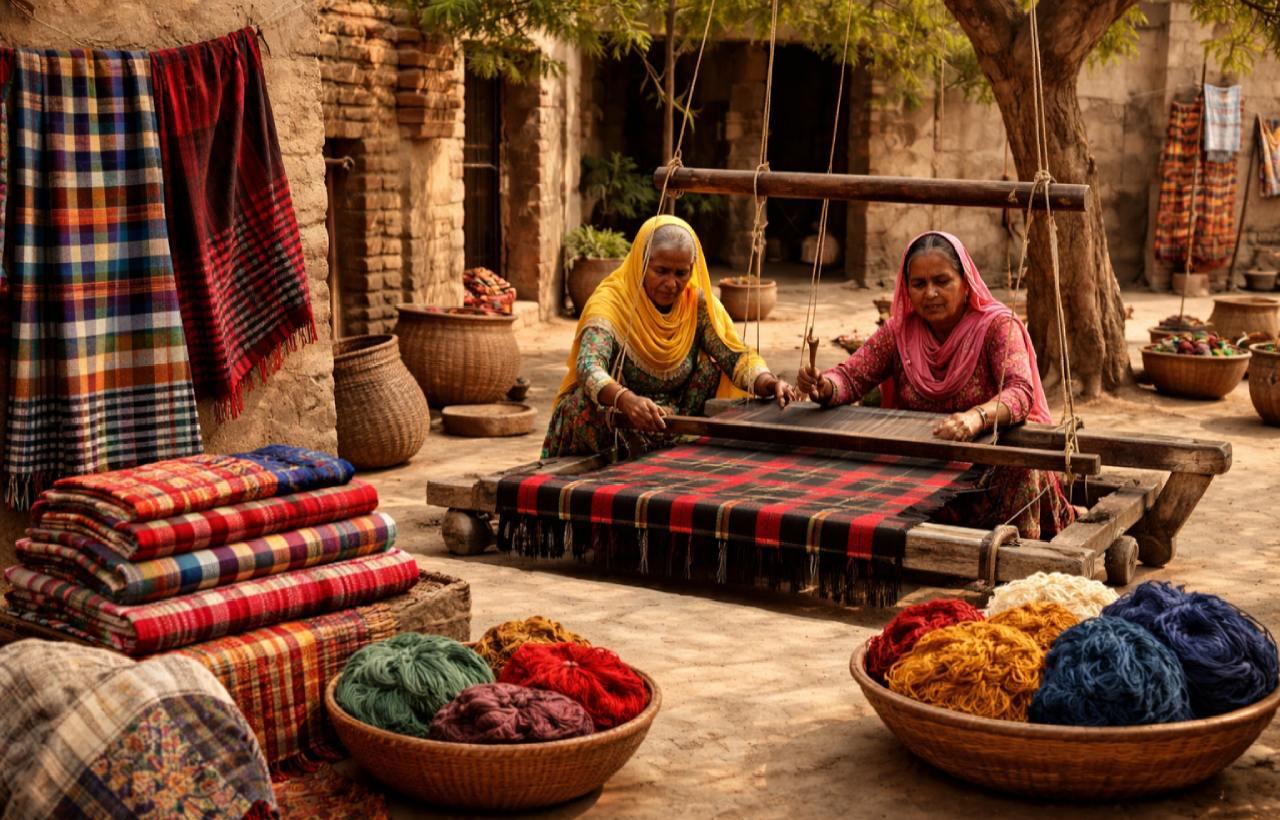
Across the rural landscapes of Punjab, textiles have historically played a vital role in everyday life and domestic culture. Among the region’s traditional fabrics, khes stands out as a humble yet culturally significant handwoven textile that was once an essential component of Punjabi households. Characterised by bold checks, stripes, and geometric patterns, khes served not only as a utilitarian fabric but also as a symbol of warmth, craftsmanship, and community identity. Although the craft now survives only in limited pockets, its history reflects a deep connection between people, place, and textile traditions.
Origins and Historical Background
Khes weaving originated in the Punjab region of the Indian subcontinent, historically encompassing areas that now fall within both India and Pakistan. While the craft gained prominence during the nineteenth and early twentieth centuries, the broader tradition of cotton weaving in the region dates back much earlier, particularly to the Mughal period when textile production flourished under royal patronage. Traditionally, khes was woven as a thin cotton blanket or covering intended for everyday domestic use. Its versatility allowed it to function as a bedspread, shawl, wrap, or floor covering during gatherings and ceremonies. In rural households, khes was often woven by women using simple pit looms installed within the home. Consequently, the making of khes became closely associated with domestic craftsmanship and familial care. In many Punjabi communities, khes also carried emotional and cultural significance. Mothers and grandmothers frequently wove khes pieces for daughters as part of their dowry, symbolising protection, warmth, and continuity of tradition. Over time, particular patterns and colour combinations came to represent regional identities and local preferences.
Textile Structure and Weaving Types
The structure of khes is defined by relatively simple yet effective weaving techniques that produce a durable and breathable fabric. The most common weave structures include plain weave and twill weave. In a plain weave, warp and weft threads intersect alternately, producing a balanced and strong fabric structure. This technique creates the characteristic grid-like patterns seen in many khes textiles, where bold checks and stripes emerge through the use of alternating coloured yarns. In certain regions, particularly in western Punjab (now part of Pakistan), weavers historically practiced double cloth weaving, a more complex technique in which two layers of fabric are woven simultaneously and interchanged to form intricate patterns. Double-cloth khes often displayed more elaborate motifs and were reversible, making them highly valued. The weaving process was traditionally carried out on pit looms, locally known as ‘khaddi’. These looms are partially installed below ground level, allowing the weaver to maintain better tension and control while producing sturdy cotton textiles. Due to the limited width of traditional looms, khes was typically woven in two narrow panels, which were later stitched together along the centre seam to form a wider textile.
Materials and Dyeing Practices
Cotton yarn is the primary material used in khes weaving. Historically, coarse hand-spun cotton was commonly used, giving the fabric its characteristic texture and weight. In certain cases, finer cotton or cotton–silk blends were incorporated, particularly for ceremonial or special purpose pieces. Traditional khes textiles relied heavily on natural dyes derived from plant and mineral sources. Indigo produced deep blue shades, madder root generated rich red tones, turmeric provided yellow hues, and ferrous oxide produced darker shades. These colours were often combined to create striking contrasts in the woven patterns. Because the design of khes emerges from the interlacing of coloured yarns, the dyeing and preparation of yarns play a critical role in the final textile. Warp threads are carefully arranged according to the intended pattern so that stripes and checks align precisely once the fabric is woven.
Motifs, Designs, and Patterns
Historically, khes textiles could be easily identified by their provenance, lineage, and status through variations in weave structures, patterns, colour combinations, and yarn quality. Khes originating from western Punjab, particularly from regions such as Sindh, Sargodha, and Multan, were distinguished by vibrant colours and complex patterns. These textiles typically featured smaller all-over motifs in the body, complemented by bold geometric borders forming a char bagh layout at the four corners. Such textiles were known as Majnoo Khes, sometimes referred to as Laila-Majnoo Khes or Sindhi Khes. Majnoo khes were thicker and heavier due to the double-cloth weaving technique. The additional threads often created contrasting colour compositions on either side, making the fabric reversible. These textiles typically ended with tightly woven bands and finely hand-rolled tassels. Another variation was Gumti Khes, characterised by smaller repetitive motifs across the body and simple borders. The motifs, often called buto in the Sindh region, were created using the dobby weaving technique. Unlike Majnoo khes, Gumti khes were lighter and more flexible, making them suitable for use as shawls or coverlets.
Several patterns carried distinctive regional names, including:
- Moonch Marod (also called Thunvaan Khauri)–resembling a scorpion motif
- Bulbul Chashm–meaning ‘eye of the nightingale’
- Gul Chaman–floral garden motif
- Billi Buto–cat’s paw motif
- Kuttae Paer–dog’s paw motif
- Punj Gul–a five-petaled flower design
Simpler textiles known as Saada Khes were woven in plain, twill, or herringbone weaves. These textiles often featured striped or checkered patterns and were lighter compared to the dense double-woven khes. Saada khes frequently displayed a distinctive cord like detail a few inches inward from the selvage before the tassels began.
Processes, Tools, and Techniques
The production of khes involves several stages, each requiring skill and careful attention. The process begins with raw cotton procurement and spinning. Cotton, locally known as ‘soot’, was spun into coarse yarn using hand spindles or the ambar charkha. The resulting yarn typically ranged between 20s and 30s counts and often displayed a slightly slubbed texture. The spun yarn was preserved in large skeins and taken to local dyers, known as ‘rangrez’, who washed the yarn to prevent shrinkage and dyed it using natural pigments. After dyeing, the yarn was wound onto spools for warping. The weaving process was carried out on pit looms, which were installed over pits approximately 24 to 28 inches deep. The pit helped maintain moisture levels and improved weaving conditions. Both men and women participated in the weaving process, although many oral accounts suggest that women traditionally played a major role. Patterns in khes were largely weft driven, meaning the motifs emerged through careful manipulation of the weft threads. The threads were compacted using a comb like tool known as ‘hatthi’ or ‘kanghi’, which ensured tight and even weaving. By the late 1960s, many khes weaving centres transitioned to power looms, although some smaller centres and individual artisans continued producing handwoven khes for commissioned orders.
Cultural Meaning and Social Role
Beyond its technical characteristics, khes occupies an important place in the social and cultural life of Punjab. In rural households, it served as a versatile textile used for bedding, shawls, wraps, and floor coverings during gatherings. For elderly women, khes often functioned as a shawl-like wrap, providing warmth and modesty. Because many khes were woven within the household, the textile carried a strong emotional connection between the maker and the user. The association of khes with dowry traditions further strengthened its cultural significance. A khes woven by a mother or grandmother symbolised care, continuity, and blessings for a daughter beginning a new life in another household.
Partition and Transformation of the Craft
The Partition of India in 1947 had a profound impact on khes weaving. Before the political division, khes production extended across the entire Punjab region, facilitating exchange of techniques and cultural influences. Western Punjab, which became part of Pakistan, had a strong tradition of double-cloth khes weaving with complex patterns. Eastern Punjab in India primarily produced simpler striped and checked khes. Partition disrupted these networks of artisans and knowledge exchange, resulting in the gradual disappearance of certain weaving traditions, particularly the double-cloth technique on the Indian side.
Present Day Challenges
Today, khes weaving faces several challenges that threaten its survival as a living craft tradition. One major challenge is competition from machine-made textiles, which are widely available at lower prices. Additionally, the number of skilled artisans has declined significantly, as younger generations often seek alternative occupations offering greater economic stability. In areas where khes is still produced, weavers frequently work with standardised designs intended for low-cost markets. This has led to a decline in both the diversity of patterns and the quality of the fabric. Furthermore, the disappearance of traditional knowledge systems has resulted in the loss of complex techniques such as double-cloth weaving.
Efforts Towards Revival
Despite these challenges, khes has recently begun to attract renewed attention among designers, researchers, and craft organisations. Vintage khes textiles are increasingly valued for their distinctive aesthetics, durability, and cultural heritage. Contemporary designers are experimenting with khes patterns and structures to develop products such as scarves, stoles, upholstery fabrics, and home décor textiles. These adaptations aim to create new market opportunities while preserving the visual identity of the traditional fabric. Such initiatives also align with the growing global interest in sustainable and handmade textiles. Handloom fabrics like khes require minimal energy and rely largely on natural materials, making them environmentally responsible alternatives to industrial textile production.
 marketing@alchempro.com