


Origins of Protection
Humans are the only primates without fur to protect themselves from the elements.
Early communities relied on animal skins and furs for insulation against cold climates or protection from intense sun, and over 5,000 years ago, woven fabrics from plant fibres and wool introduced greater flexibility and comfort. These early textiles provided warmth, softness and breathability, as well as inherent UV shielding. The development of dyeing techniques gradually transformed textiles from purely functional objects into cultural and aesthetic expressions, laying the foundations of fashion.
Yet for all their advantages, all fabrics retained one fundamental vulnerability, i.e., rain. Water penetration compromised thermal insulation, increased garment weight and accelerated degradation. Protection against precipitation became a persistent technical challenge.
Macintosh’s Breakthrough
There is some evidence that the Aztecs may have waterproofed garments using natural rubber, but it was not until the 19th century that a scalable industrial solution emerged. The Scottish textile manufacturer and inventor Charles Macintosh impregnated thick woollen cloth with a solution of natural rubber, initially producing a waterproof fabric that suffered from stickiness and a pronounced petroleum odour. Only after refining the process by coating the fabric on one side and heating the rubber with sulphur in a dryer (the process later formalised as vulcanisation) did the Mackintosh coat become commercially viable.
That development in the 1820s was more than the origin of the raincoat. It represented one of the earliest examples of systematic surface engineering in textiles. Instead of changing the fibre, the yarn or the weave, performance was modified at the surface. The principle was simple yet transformative: apply a controlled layer to alter function.
Two centuries later, the same principle underpins some of the most advanced technical textiles on the market.
The distinction between immersion finishing and controlled surface coating has once again become central. Today, however, the drivers extend beyond waterproofing. They include resource efficiency, precise chemistry management, digital reproducibility and differentiated performance characteristics tailored to specific end uses.
Precision Coating Today
In recent years for example, German textile finishing machinery specialist Monforts has significantly advanced its coating technologies through the introduction of the MontexCoat and coaTTex systems. Designed for the technical textiles market, these platforms combine flexibility, precision application and energy efficiency in ways that reflect the sector’s new priorities.
In performance apparel, coating technologies are enabling finely balanced combinations of water resistance, wind protection and breathability. In outdoor and architectural textiles, including tents, awnings, sailcloth and blackout blinds, coatings provide dimensional stability, opacity control and weather durability. Rather than relying on bulk fabric construction alone, manufacturers can fine-tune performance at the surface layer.
Industrial Applications Expanding
Transport interiors represent another major field of application. Automotive upholstery and interior fabrics require abrasion resistance, controlled tactile properties, stain resistance and long-term durability under fluctuating temperature and humidity conditions. Coatings can positively influence each of these parameters.
Crucially, automotive suppliers demand absolute reproducibility across production batches. Digitally stored coating recipes that can be reloaded and replicated ensure identical outcomes, aligning surface engineering with the data-driven expectations of modern supply chains.
Beyond consumer-visible products, coating technologies are integral to a wide array of industrial applications. High-temperature filter media require carefully measured surface treatments to maintain airflow while resisting chemical degradation. Flame-retardant barrier fabrics depend on precise deposition of functional chemistries. Heavy membranes for biogas storage systems must meanwhile combine mechanical strength with impermeability and weather resistance. Carbon fibre prepregs and composite reinforcement fabrics demand coating precision measured in microns, as deviations directly affect mechanical performance in downstream composite structures.
Application Technologies Defined
Behind these performance outcomes lies a spectrum of highly specialised coating techniques, each selected according to substrate, chemistry and end-use requirements. Among the most widely employed systems in technical textiles are air knife and roller knife coating technologies, both of which allow exceptional control over application weight, penetration depth and surface characteristics.
Air knife coating is typically associated with the application of thickened pastes but is equally compatible with foam systems. In foam coating, a physical foam is generated in a dedicated foam unit (not unlike whipped cream in structure) and introduced directly in front of the coating knife. As the knife presses the foam into the fabric, the air structure collapses and the chemistry is deposited evenly across the surface.
This so-called unstable foam coating should not be misunderstood. The foam remains structurally stable below room temperature for several minutes, yet its air bubbles are designed to burst either under mechanical pressure at the knife or during subsequent thermal treatment in the dryer. The controlled collapse of the foam ensures uniform application while significantly reducing the volume of liquid introduced into the textile.
The advantages are considerable. By effectively diluting coating chemistry with air rather than water, drying energy requirements are reduced. Penetration depth can be carefully limited, and the inherent breathability of the textile substrate can be preserved.
Roller knife coating, sometimes referred to as roller nip coating, operates on a different principle. Here, the coating compound is applied within the nip between rollers, effectively ‘flying’ onto the textile without direct contact with the upper surface. This technique enables the formation of continuous, often polymer-rich surface layers that can impart a plastic-like character determined by the chemistry used.
Mechanical Precision
Well-known examples of roller knife coated textiles include tarpaulins, life jackets, carpet backings, upholstery fabrics, trunk covers and sealing materials. The process demands extremely high mechanical precision. Knife alignment, pressure consistency and gap control must be exact, particularly when applying high-viscosity pastes or multi-layer constructions. For this reason, many modern systems offer horizontal adjustability of the knife bar and combine air knife and roller knife capabilities within a single installation.
Foam systems are also used in roller knife coating. When unstable or so-called metastable foams are applied in this way, they collapse in the initial dryer zones, allowing surface dyeing effects similar to those achieved in denim finishing. Stable foams, by contrast, are engineered to survive the drying process under controlled conditions and exit the dryer as a foam layer.
One of the most demanding examples of stable foam roller knife coating is the production of black-out fabrics for blinds and curtains. These applications require complete light impermeability while retaining softness and flexibility, enabling blinds to be wound without cracking or stiffness. A typical black-out construction involves a three-stage series of stable foam coatings applied sequentially with a roller knife (commonly white, then black, then white again). Each layer is dried and crushed before the next is applied and a final curing stage fixes the layer structure. The process is technically complex and expensive, and any deviation can result in the rejection of an entire production run.
A similar multi-layer stable foam approach is used in block-out advertising banners, where opacity is required to prevent printed graphics from showing through on the reverse side.
Breathability
The lineage from Macintosh’s rubberised fabric is also visible in roller knife applications of elastomeric coatings. Rubber layers can be applied with such impermeability that the resulting textiles are suitable for lightweight boats life rafts, inflatable emergency slides and life jackets. However, while completely waterproof, such materials are not breathable, presenting a well-known challenge in apparel.
The textile industry’s response was the development of waterproof yet breathable systems. Membrane laminates such as Gore-Tex achieve this through microporous film structures bonded to textiles, but breathable polyurethane dispersions have also enabled direct coating of the inner fabric surface using roller knife systems. Depending on required performance characteristics, both paste coatings and stable foam coatings are employed.
Lamination
Lamination technologies extend this logic further. Lamination involves bonding two or more textile, film or membrane layers using adhesive systems applied by coating or screen processes. In wet lamination, the adhesive is applied to the first substrate and the second layer introduced while still wet, before drying and fixation. This method can produce relatively rigid composites. Dry lamination, by contrast, applies and dries the adhesive before the second layer is introduced under high pressure, typically via a calender, resulting in improved handle.
A specialised variant is stable foam lamination. Here, a foam adhesive layer is applied via roller doctor blade and carefully dried. The second substrate is introduced into the dry foam using a crush calender and the laminate is subsequently thermally fixed. Polyurethane foam laminates in particular can provide a softer touch and improved thermal resistance, as the adhesive becomes non-thermoplastic after curing.
“Montex stenters and Thermex dyeing systems are the industry standards for the dyeing and finishing of technical textiles, providing advantages in terms of production throughput and especially in energy efficiency and savings,” says Monforts’ marketing manager Nicole Croonenbroek. “These machines remain unmatched in terms of their robustness and long service life, as well as resource-efficient productivity. As a third strand of our business, our coating technologies are now being rapidly adopted by technical textile manufacturers, as the industry recognises their benefits.”
Value Chain Migration
The strategic importance of coating is now closely linked to structural shifts in global textile manufacturing. For decades, many companies in major production regions in Asia built their business models on high-volume, cost-driven garment manufacturing, but that model is now under increasing strain from margin compression, nearshoring trends, regulatory compliance costs and automation in mature markets.
Forward-looking regional players are therefore moving up the value chain into technical textiles, where functional differentiation commands higher margins and where capital investment in advanced finishing can provide defensible competitive advantages. It is in this context that Monforts has recently installed a number of new coating lines in Türkiye.
“Türkiye’s specific difficulties due to rising production costs and intensified competition in 2025 have been well documented, but nevertheless, we have been encouraged by the readiness of forward-thinking companies to adopt the latest technologies in order to gain competitive advantages,” observes Monforts area sales manager Thomas Päffgen. “Contrary to its general textile industry, Türkiye’s technical textiles sector maintained growth in both value and strategic importance in 2025 and the country remains the bridge between Europe and Asia.”
Türkiye’s deeply integrated value chain, spanning fibre production through to garment manufacture within a tightly connected domestic ecosystem, provides structural resilience. A skilled workforce, strong technical know-how and decades of export experience further reinforce its position as a bridge between Europe and Asia. Ongoing investment in modern coating and finishing technologies is enabling manufacturers to reinforce margins even as price competition intensifies in conventional segments.
India’s Strategic Shift
A parallel story is unfolding in India, where UK-based machinery developer Amba Projex has recently installed multiple advanced coating lines to meet rising demand in the Indian technical textiles market.
Candour Techtex, for example, has installed two Amba coating machines at its latest plant in Malegaon in Maharashtra.
“The future for the technical textile industry in India is very positive, with increasingly strong consumption rates in the domestic market and growing demand for exports,” says Candour managing director JR Mehta. “Significant volumes of coated and laminated technical textiles are currently imported into India, creating opportunities for domestic production and import substitution. By investing in coating capabilities, manufacturers can capture higher value domestically while also developing competitive export propositions. In particular, the new Amba Projex systems enable blackout fabrics to be produced efficiently and at scale.”
Scale and Dynamism
“We operate across five continents, but India remains a priority market due to its scale, dynamism and accelerating shift towards value-added textiles,” says Amba Projex MD Barry Goodwin. “The country’s rapid growth, expanding production base and appetite for advanced machinery are creating fertile ground for innovation and investment.
“Manufacturers should build on what they already do well, and if they are weaving greige cloth that will be coated or laminated, they should consider investing in the equipment to do it themselves. This shift from outsourcing to in-house value addition can significantly improve margins and reduce dependency on external players.”
He also stresses the importance of taking an incremental approach. “Instead of heavy upfront investment in basic machinery, we recommend utilising existing equipment, outsourcing select processes, and gradually integrating backward operations, because a project should pay back in one to two years, otherwise it is not a viable technical textiles venture.”
Spray Technology Evolution
Further advances in functional performance are emerging through spray application technologies. BW Converting’s TexCoat G4 system enables softeners, antimicrobials, durable water repellents, flame retardants and other water-based chemistries to be applied with exceptional precision.
“TexCoat G4 spray technology was developed in Sweden from our off-set printing business, and we initially focused on installing units in Europe and the US,” explains BW Converting vice president of global business development Rick Stanford. “In the past two years, however, we have been very active in Asia, with 35 units sold.”
Compared to traditional pad application processes, spray systems can reduce water, chemistry and energy consumption by up to 50 per cent. Chemistry is applied only where required, on one or both sides of the fabric, eliminating unnecessary saturation. This is particularly beneficial when applying water repellents to laminated fabrics, as it prevents chemistry from compromising adhesion layers. Non-contact application avoids bath contamination and eliminates downtime during colour or fabric changeovers. Over-sprayed chemistry is recycled and reduced wet pick-up levels enable combined processes or the elimination of certain drying steps.
Digital Process Control
Equally important is the integration of digital control. Automated recipe management, speed tracking, fabric width compensation and real-time monitoring of chemistry usage transform finishing from an artisanal adjustment process into a data-governed operation. As such, surface engineering becomes measurable, repeatable and auditable.
In this broader context, automation and digital process control are no longer aspirational upgrades but operational necessities. The industry’s emphasis is shifting from incremental efficiency gains towards systemic resilience, i.e., production models that are flexible, traceable and capable of responding to regulatory and market shocks. Machinery and software are now not ends in themselves, but instruments of strategic stability.
“Innovation serves both as a lever for efficiency and a driver of growth,” said Elgar Straub, managing director of the VDMA Textile Care, Fabric and Leather Technologies, at a Messe Frankfurt press conference ahead of Techtextil and Texprocess in January. “Digitalisation, automation and AI are enabling companies to conserve resources, produce flexibly and reposition themselves more effectively and competitively.”
Olaf Schmidt, vice president textiles and textile technologies at Messe Frankfurt, further emphasised that the Techtextil and Texprocess exhibitions are platforms where ideas evolve into market-ready solutions.
Protective Performance Systems
Nowhere are the stakes of advanced coating and finishing more evident than in protective and defence applications, which will feature prominently at Techtextil.
Modern military uniforms are engineered systems rather than simple garments. Durable water-repellent finishes reduce surface energy so rain beads and rolls off while maintaining breathability. Oil-repellent variants protect against fuels and lubricants in mechanised environments, and antimicrobial coatings based on silver ions or other biocidal agents reduce bacterial growth during extended deployments.
Flame resistance may be achieved through inherent fibre solutions, such as aramid blends, or through topical flame-retardant coatings. In high-risk environments, heat-reflective or intumescent coatings provide additional protection. In tropical and disease-prone regions, uniforms may also be treated with permethrin bonded to fibres to repel insects across multiple wash cycles. Infrared reflective pigments are integrated into dyes and coatings to control near-infrared reflectance under night-vision systems. Specialised CBRN garments incorporate barrier coatings, activated carbon layers or semi-permeable membranes to block hazardous agents while allowing moisture vapour transmission.
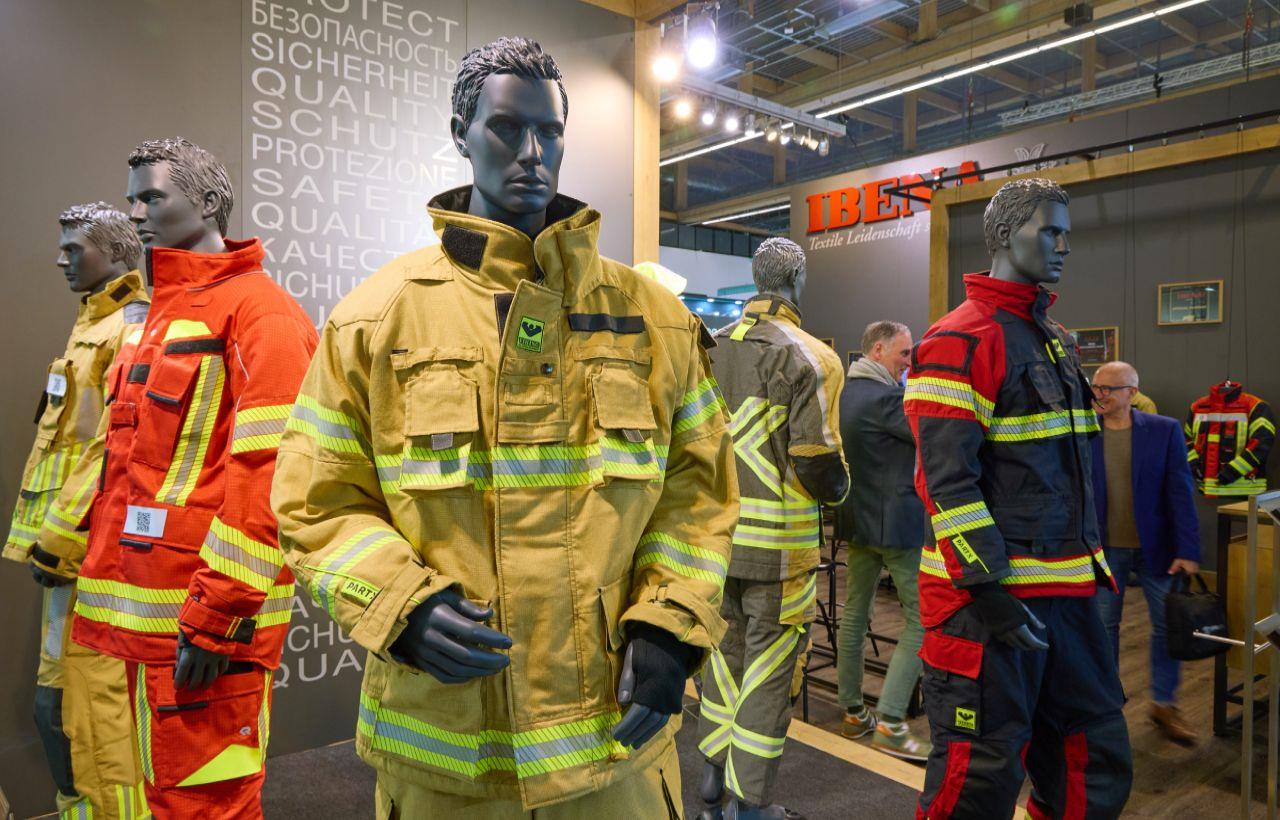
Police, fire and rescue professionals require garments that combine a professional appearance with sportswear-like performance characteristics, including stretch, moisture management, rapid drying and weather protection. Across these sectors, surface engineering is not decorative but decisive.
A $230 Billion Market
According to forecasts by Swiss consultancy Gherzi, global roll goods for technical textiles will be worth $230 billion in 2026. Of this total, $48 billion will be generated by nonwovens and $43 billion by reinforcing composites. By tonnage, approximately 53 million tons of technical textiles will be manufactured and sold, spanning conventional weaving, knitting and braiding, nonwovens and composite reinforcements.
More than 1,700 companies from 51 countries will participate in Techtextil and Texprocess, including performance chemicals suppliers and technical fabric manufacturers across multiple end-use sectors. The scale of participation underscores both the diversity and the strategic importance of the industry.
From Macintosh’s vulcanised fabric in the 1820s to today’s digitally controlled spray systems, the long pursuit of protection has evolved into a sophisticated science of surfaces.
In Frankfurt, that evolution will be visible not merely as a collection of materials and technologies, but as evidence of an industry consciously redesigning itself. Coating and finishing, once considered ancillary processes, now sit at the centre of the technical textiles narrative. They are the instruments through which manufacturers defend margins, reduce resource consumption and engineer resilience for a more demanding world.
The Mackintosh raincoat brand, meanwhile, is currently owned by the Japanese fashion group Yagi Tsusho, but still made in the brand’s two UK factories in Nelson, Lancashire, and Cumbernauld, Scotland.

 marketing@alchempro.com