



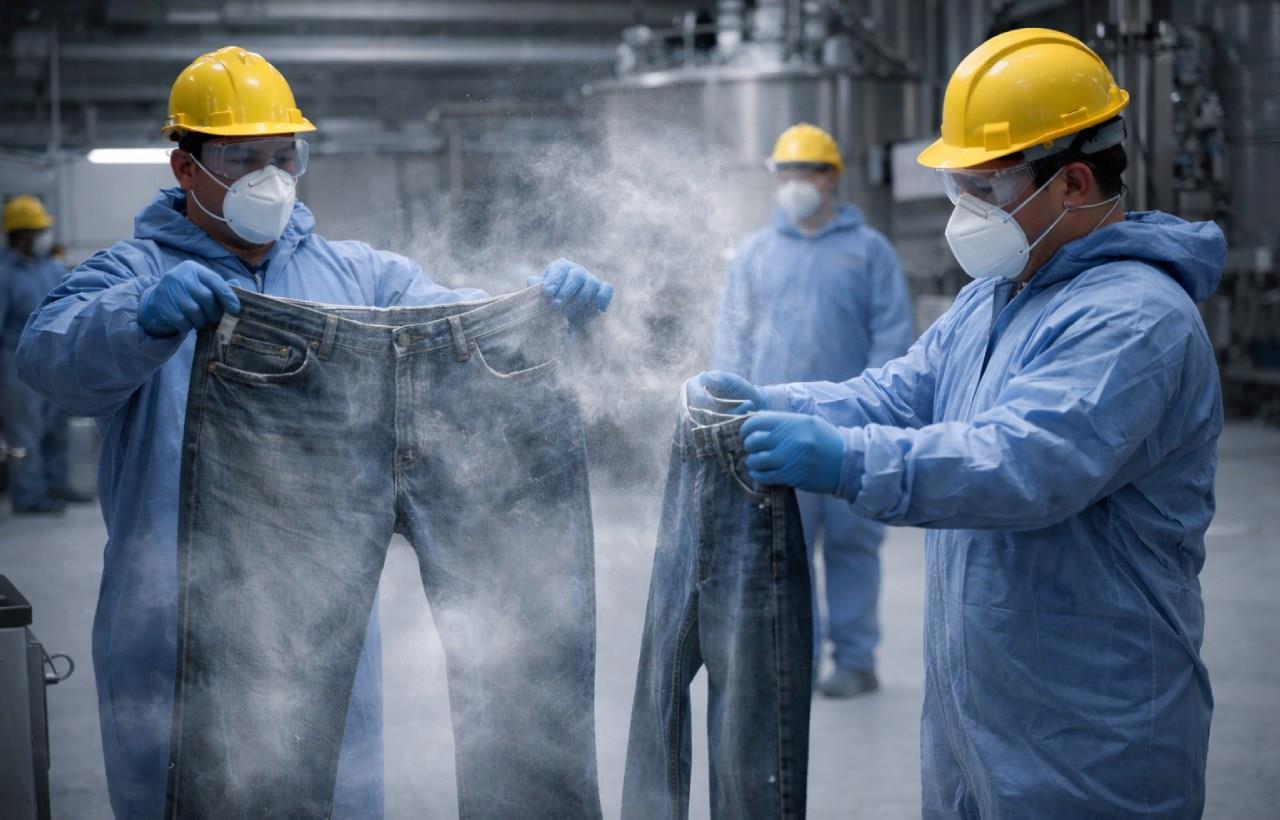
The global fashion and textile industry is undergoing a transformation driven by sustainability, efficiency, and innovation. Among the key enablers of this shift is the increasing use of enzymes—biological catalysts that replace harsh chemicals in processes such as desizing, bio-polishing, and denim finishing. While enzymes offer environmental and performance advantages, they also introduce a lesser discussed but critical concern: enzyme dust and occupational exposure risks.
As production scales up to meet global demand, the frequency and intensity of worker interaction with enzyme formulations have also increased, elevating potential exposure levels. This makes it essential for manufacturers to balance sustainability goals with robust occupational health safeguards. Greater scrutiny from regulators and sustainability frameworks is further pushing the industry to address these hidden risks more proactively.
This article explores the science, risks, real-world implications, and preventive strategies associated with enzyme dust exposure in textile and fashion manufacturing.
The Role of Enzymes in Modern Textile Processing
Enzymes are protein-based catalysts used to accelerate chemical reactions without being consumed in the process. In textile manufacturing, they are widely applied in:
Desizing: Enzymes such as amylases are used to break down starch-based sizing agents applied during weaving. This process ensures efficient removal of residues without damaging the fibres, improving fabric absorbency and preparing it for subsequent wet processing stages.
Bio-polishing: Cellulase enzymes are applied to remove microfibrils and surface fuzz from cotton and other cellulosic fabrics. This enhances fabric softness, reduces pilling, and improves colour brightness and sheen, resulting in a higher-quality finish.
Denim finishing: Enzymatic treatments, particularly with cellulases, are used as an alternative to traditional stone washing. They help create a worn, faded look while reducing fabric damage, lowering water usage, and minimising the mechanical stress associated with pumice stones.
Scouring and bleaching: Enzymes such as pectinases, lipases, and catalases are used to remove natural impurities like waxes, pectins, and residual hydrogen peroxide. This enables cleaner fabric preparation with reduced reliance on harsh alkalis and oxidising agents, leading to lower chemical loads in effluent.
Dyeing and colour enhancement: Certain enzymes assist in improving dye uptake and fixation, ensuring more uniform colouration and reducing dye wastage. This contributes to better colour fastness and overall process efficiency.
Wastewater treatment and sustainability support: Enzymes are increasingly used in treating textile effluents by breaking down organic pollutants, thereby supporting compliance with environmental regulations and reducing the ecological footprint of textile operations.
Their adoption has grown significantly due to their ability to reduce water consumption, lower energy use, and minimise toxic chemical discharge. However, the same biological properties that make enzymes effective also contribute to their potential health risks, especially when they become airborne.
Understanding Enzyme Dust
‘Enzyme dust’ refers to fine airborne particles released from powdered enzyme formulations during handling processes such as mixing, transferring, or dosing.
These particles are often:
- Microscopic and easily inhalable
- Difficult to contain in open industrial settings
- Capable of remaining suspended in air for extended periods
Due to their protein-based structure, these particles can trigger biological responses even at very low concentrations once inhaled. The risk is further amplified in poorly ventilated environments where airborne particles can accumulate over time. Additionally, repeated low-level exposure may go unnoticed initially but can lead to sensitisation and more severe health effects with continued contact. Environmental factors such as humidity, airflow patterns, and the method of material handling can further influence how widely these particles disperse within a workspace. Activities like pouring, weighing, or mechanical agitation can significantly increase dust release, intensifying short-term exposure levels. Over time, even intermittent exposure under such conditions can contribute to cumulative health risks for workers.
This phenomenon is described as ‘dustiness’, a key determinant of exposure risk alongside enzyme concentration.
Occupational Health Risks: What Happens When Workers Are Exposed?
1. Respiratory Sensitisation and Allergies
Enzymes are proteins, and when inhaled, they can act as respiratory sensitisers. Repeated exposure may lead to:
- Occupational asthma
- Allergic rhinitis
- Chronic respiratory irritation
Studies1 have shown that enzyme exposure has historically caused respiratory allergy outbreaks, particularly in industrial settings like detergent manufacturing.
2. Long-Term Respiratory Conditions
Exposure to airborne particulates in textile environments, including enzyme dust, can contribute to broader respiratory issues. For example:
- A study in textile workers found that 18 per cent exceeded recommended dust2 exposure limits during work shifts.
Elevated endotoxin levels in textile environments were found to be over 20 times higher than health-based guidance values, indicating significant respiratory risk.
Although this data includes general textile dust, it highlights how airborne particles, including enzyme dust, can compound occupational health risks.
3. Regulatory Thresholds and Exposure Limits
To mitigate risks, occupational safety bodies have established exposure limits. For example:
- An occupational exposure limit (OEL) of 60 ng/m³ exists3 for certain protease enzymes used in textile processing.
Such low thresholds reflect the high sensitisation potential of enzymes, even at minimal concentrations.
Why Enzyme Dust Exposure Persists in Fashion Supply Chains?
Despite known risks, enzyme dust exposure remains a concern due to several structural and operational challenges:
1. Inconsistent Safety Practices
Many textile facilities, especially in developing manufacturing hubs, lack:
- Adequate ventilation systems
- Airborne particle monitoring
- Standardised safety protocols
This leads to uneven implementation of safety measures across the industry. In many cases, safety investments are deprioritised in favour of cost efficiency and production speed, particularly in highly competitive markets. Smaller and medium-scale units may also lack access to advanced technologies or technical expertise required to manage airborne contaminants effectively.
2. Reliance on Powdered Enzymes
Powder formulations are still widely used due to:
- Lower cost
- Easier transportation
- Longer shelf life
However, they are also the primary source of airborne enzyme dust. Their fine particulate nature makes them highly dispersible during manual handling, increasing the likelihood of inhalation. In facilities where automation is limited, frequent manual dosing and mixing further elevate exposure risks. Despite the availability of safer alternatives, the transition is often slow due to cost constraints and lack of regulatory pressure.
3. Limited Awareness and Training
Workers may not be fully aware of:
- The long-term risks of inhalation
- Proper handling procedures
- Importance of personal protective equipment (PPE)
This gap in awareness can result in inconsistent use of protective gear and unsafe handling practices on the shop floor. Training programmes, where they exist, may be infrequent or not sufficiently detailed to address specific risks associated with enzyme exposure. Additionally, language barriers and varying literacy levels in the workforce can further limit the effectiveness of safety communication and compliance.
Industry Response: Moving Towards Safer Alternatives
Recognising the risks, industry organisations and certification systems are increasingly promoting safer practices.
1. Shift to Liquid and Encapsulated Enzymes
Liquid formulations and coated granules:
- Reduce airborne particle release
- Improve dosing accuracy
- Minimise worker exposure
Some certification systems have gone further by restricting the use of powder enzymes altogether in approved textile production.
2. Adoption of the ‘Hierarchy of Controls’
Effective risk management follows a structured approach:
- Elimination/Substitution – Replace powder enzymes with safer forms
- Engineering Controls – Enclosed systems, ventilation, dust extraction
- Administrative Controls – Training, process standardisation
- PPE – Masks, respirators, protective clothing
This multi-layered strategy is essential for reducing exposure risk.
Implications for the Fashion Industry
The issue of enzyme dust intersects with broader themes in fashion:
1. Ethical Manufacturing
Worker safety is increasingly tied to brand accountability. Consumers and stakeholders are demanding:
- Transparent supply chains
- Safe working conditions
- Responsible chemical management
Brands are now expected to go beyond compliance and actively ensure that their sourcing practices do not compromise worker health at any stage of production. Increased public scrutiny, driven by media and advocacy groups, has made occupational safety a visible component of corporate social responsibility.
2. Sustainability vs. Safety Trade-Off
While enzymes are promoted as eco-friendly alternatives, their use must be balanced with occupational health considerations.
This highlights a critical need to adopt a more holistic definition of sustainability, one that equally prioritises environmental impact and human well-being. Therefore, integrating health impact evaluations into sustainability strategies is essential to avoid shifting risks from the environment to workers.
3. Regulatory and Certification Pressure
Frameworks such as sustainable textile certifications are pushing manufacturers to:
- Eliminate hazardous inputs
- Implement safer chemical formulations
- Monitor workplace exposure
Compliance with these frameworks is increasingly becoming a prerequisite for market access, particularly in international supply chains. Certifications not only drive safer practices but also encourage continuous improvement through regular audits and performance benchmarks. As regulations tighten, companies that proactively adopt higher safety standards are likely to gain a competitive advantage and strengthen their position in the global market.
The Way Forward
Addressing enzyme dust exposure requires coordinated action across the value chain:
- Manufacturers must invest in safer formulations and engineering controls. This includes transitioning to low-dust or liquid enzyme formulations, implementing closed dosing systems, and installing effective local exhaust ventilation to minimise airborne dispersion at the source.
- Brands must prioritise supplier compliance and transparency. Brands can ensure that safety standards are consistently maintained across global supply chains by integrating occupational health criteria into sourcing policies and audits.
- Regulators must enforce exposure limits and monitoring. Regular workplace air quality assessments, clear occupational exposure limits, and stricter enforcement mechanisms are essential to ensure compliance and accountability.
- Workers must be trained and equipped with appropriate protective measures. This involves not only providing PPE such as respirators and protective clothing but also conducting regular training on safe handling practices and risk awareness.
In addition, industry-wide collaboration and knowledge-sharing platforms can play a crucial role in standardising best practices and accelerating the adoption of safer technologies. Investment in research and innovation will further help develop enzyme solutions that are both high-performing and inherently low-risk. Continuous monitoring, reporting, and improvement should be embedded into operational frameworks to ensure long-term worker safety. Ultimately, the goal is to ensure that sustainability innovations do not come at the cost of worker health.
 marketing@alchempro.com