



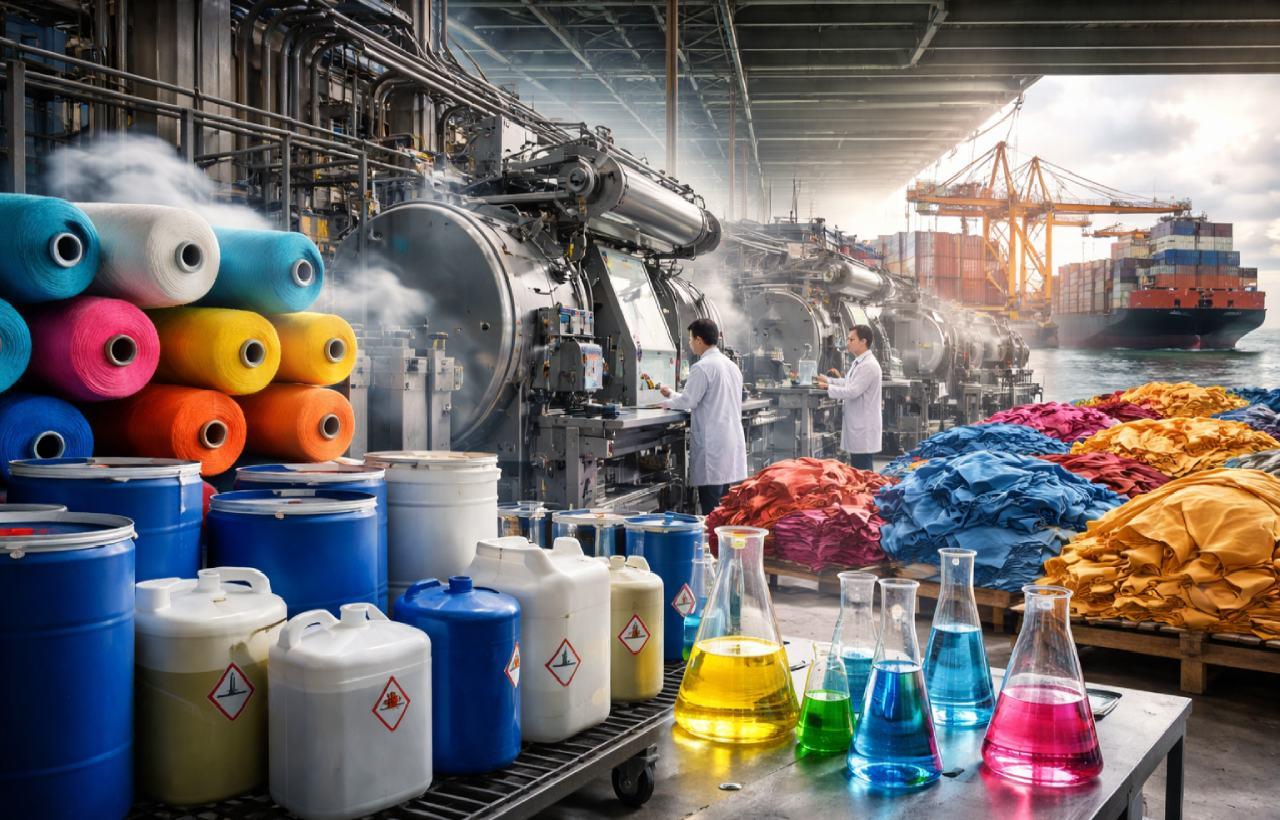
Rising tensions between the US–Israel and Iran have injected fresh uncertainty into global energy and petrochemical markets. For the textile industry, which is deeply intertwined with these inputs, the immediate concern may appear to be cost escalation. However, a more profound and less discussed risk is emerging: the continuity and consistency of supply. In an industry where precision, repeatability, and timelines define competitiveness, even minor disruptions can cascade into significant operational challenges.
A Shift from Cost to Continuity Risk
The early signals of disruption are already visible across key raw materials. The polyester value chain, heavily dependent on petrochemical derivatives, is particularly vulnerable. Inputs such as monoethylene glycol (MEG), methanol, and acetic acid are witnessing heightened volatility, while fluctuations in intermediate chemicals are beginning to impact disperse dye availability and pricing.
Beyond core inputs, auxiliary chemicals including nonionic surfactants (AEO), silicone emulsions, and finishing agents are also exposed to supply-side risks. These materials, though often overlooked, play a critical role in ensuring process efficiency and product quality. Any inconsistency in their availability or performance can disrupt finely calibrated production systems.
At first glance, these developments may be interpreted as a pricing issue. However, the operational reality is more complex. The challenge is not always the absence of a product, but the inconsistency in its availability and performance. Manufacturers may find themselves sourcing the same chemical from multiple suppliers, each offering slight variations in formulation or quality. This variability introduces uncertainty into processes that rely on precision.
Impact on Processing and Quality Control
The implications are particularly pronounced in dyehouses and processing units, where standardisation is essential. Variations in raw material quality can lead to frequent adjustments in dyeing recipes, increased laboratory workloads, and a higher number of trials to achieve the desired results.
Processes most affected include:
- Disperse dye systems, where consistency in dye uptake is critical
- Polyester dyeing processes, which are sensitive to fluctuations in chemical inputs
- Formulations dependent on auxiliary chemicals, where even minor deviations can alter outcomes
While reactive dyeing may experience a more indirect impact, the ripple effects of upstream instability can still influence overall process efficiency.
This evolving scenario introduces a new layer of operational complexity. Shade matching may become increasingly difficult, leading to higher rework rates. Delivery timelines may be affected as additional testing and corrections are required. Over time, these challenges can erode customer confidence and strain supplier relationships.
The Real Risk: Loss of Process Stability
What emerges as the most critical concern is the potential loss of process stability. In textile manufacturing, stability underpins everything from quality assurance to cost control. When inputs become unpredictable, maintaining consistent output becomes significantly harder.
This is where the industry’s traditional focus on cost optimisation may prove insufficient. The ability to secure the lowest-priced raw material offers little advantage if it compromises production reliability. Instead, the emphasis must shift towards building resilient systems capable of absorbing variability.
Operational and Strategic Implications
This shift has both operational and strategic consequences. On the factory floor, production planning may need to become more flexible, with buffer inventories and adaptive scheduling to manage supply inconsistencies. Procurement teams may prioritise reliability and consistency over price alone, even if it means higher upfront costs.
At a strategic level, companies may increasingly explore nearshoring or diversified sourcing models to reduce dependency on a single geography. There may also be renewed interest in backward integration or closer partnerships with chemical suppliers to ensure better control over input quality.
In addition, brands and retailers will need to recognise these challenges and recalibrate expectations around pricing, lead times, and compliance. A more balanced approach to risk-sharing across the value chain will be essential to sustain long-term partnerships.
Rethinking Industry Priorities
In this new environment, competitive advantage will increasingly depend on control rather than cost. Manufacturers will need to invest in stronger supplier relationships, diversify sourcing strategies, and enhance their technical capabilities to manage variability.
Laboratories and quality control teams will play a more strategic role, moving beyond routine testing to actively support process adaptation. Digital tools and data-driven insights may also become essential in tracking variations and optimising formulations in real time.
Collaboration across the value chain will be equally important. Transparent communication between chemical suppliers, textile manufacturers, and brands can help mitigate risks and ensure alignment in expectations.
Final Remark
For whom does the bell toll this time?
Not for those unprepared for rising costs, but for those unable to manage continuity. Because in today’s environment, the question is no longer about price. It is about how sustainably and consistently one can produce.
 marketing@alchempro.com