



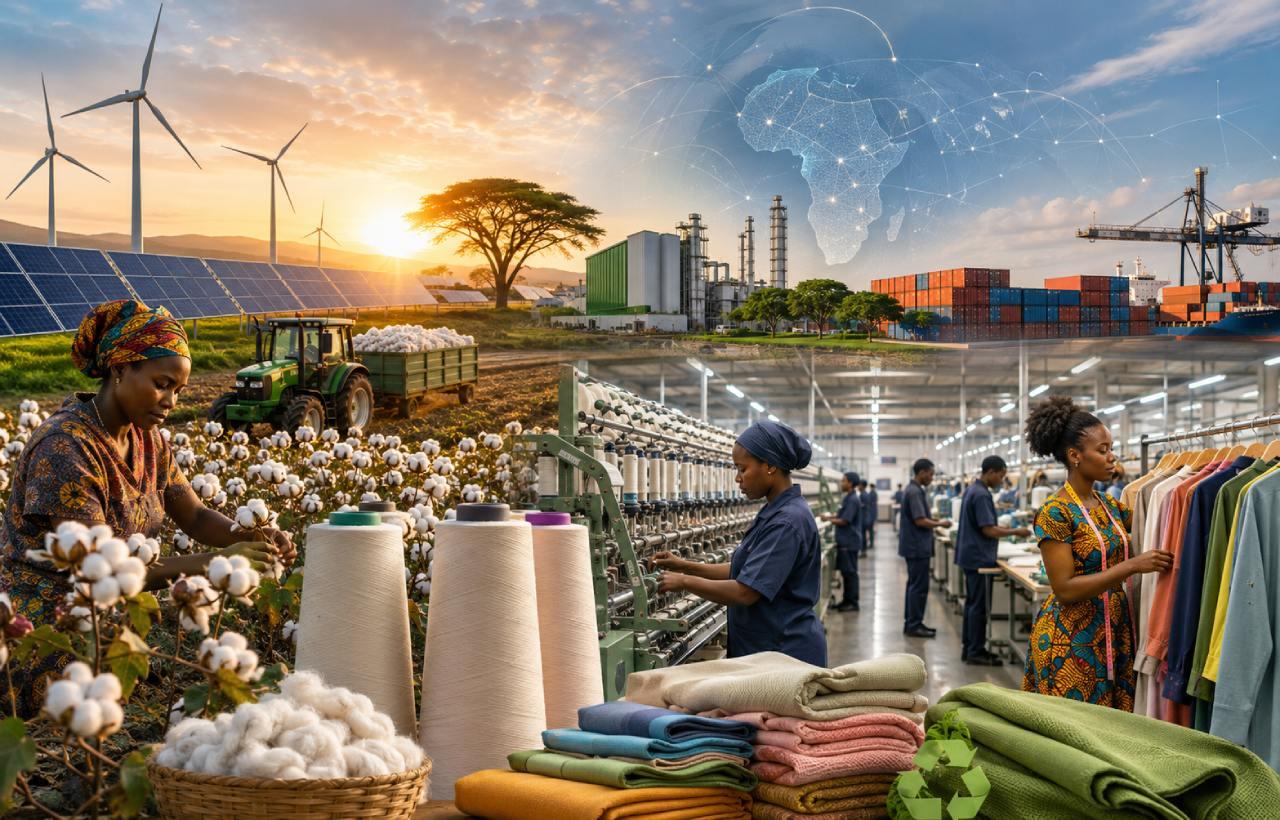
Africa’s industrial trajectory is being reshaped by the collision of three structural forces: demographic pressure, climate accountability, and the reconfiguration of global supply chains. Each of these forces, in isolation, would demand policy recalibration. Together, they are redefining the conditions under which industrialisation can occur, and who stands to benefit.
For decades, Africa’s position in global manufacturing has been constrained by a familiar set of structural barriers: high logistics costs, unreliable energy systems, fragmented markets, and limited access to long-term capital. These constraints entrenched a pattern in which the continent remained largely upstream; exporting raw materials while importing finished goods. In textiles, this translated into a persistent disconnect between Africa’s role as a major cotton producer and its marginal presence in higher-value textile and apparel manufacturing.
What has changed is not the disappearance of these constraints, but the shifting calculus of global production. Climate transition policies, particularly in major consumer markets, are beginning to internalise environmental costs that were previously externalised. Scope 3 emissions, which account for the overwhelming majority of emissions in apparel value chains, are now central to corporate strategy. This is a systemic shift that is altering sourcing decisions, supplier relationships, and capital allocation.
At the same time, geopolitical fragmentation and pandemic-era disruptions have exposed the risks of hyper-concentrated supply chains. The long-standing dominance of a few Asian manufacturing hubs is no longer viewed as an unqualified advantage. Brands and retailers are actively pursuing diversification strategies as a hedge against systemic risk.
Within this evolving landscape, Africa is entering the equation as a potential solution to multiple constraints: a new geography for supply chain diversification, a platform for lower-carbon production, and a frontier for industrial expansion. The implication is profound; Africa is a potential site for redefining existing industrial models under new global conditions.
Textiles and apparel sit at the centre of this opportunity. The sector’s structure, linking agriculture, manufacturing, and trade, makes it uniquely suited to anchor a broader industrial transformation. But its relevance extends beyond economics. It is also where the tensions of the green transition are most visible: between cost and compliance, between growth and sustainability, and between global standards and local capabilities.
The critical question is therefore not whether Africa can industrialise through textiles, but how it can do so differently. Retrofitting sustainability into existing systems has proven costly and politically contentious in established manufacturing regions. Africa’s advantage lies in avoiding this path dependency; embedding low-carbon energy systems, resource-efficient processes, and traceable supply chains from the outset.
This is the essence of the current industrial moment. It is not defined by incremental improvement, but by the possibility of structural leapfrogging. Yet this possibility is highly contingent. Without coordinated action, across policy, infrastructure, finance, and skills, the same structural constraints that have historically limited Africa’s industrialisation could reassert themselves in new forms.
Why Textiles Matter: The Strategic Role of the CTA Sector
Employment, Demographics, and Structural Transformation
Africa’s demographic trajectory is often described in terms of opportunity, but its implications for industrial policy are more immediate and more demanding. With millions entering the labour force annually, the challenge is not only job creation but job creation at scale. Few sectors offer the employment elasticity required to absorb such volumes of labour. Textiles and apparel remain one of them.
However, the employment argument extends beyond sheer numbers. The sector’s labour profile, characterised by relatively low entry barriers and a high proportion of female employment, has direct implications for income distribution and social inclusion. In many historical cases, textile manufacturing has served as an entry point into formal employment for populations transitioning out of subsistence agriculture. This transition is central to broader structural transformation, enabling productivity gains at the macroeconomic level.
Yet, employment alone is not sufficient. The quality and productivity of jobs matter equally. African textile sectors cannot rely on low wages as a sustainable competitive advantage. Instead, productivity must increase through better training, improved management practices, and technology adoption. This introduces a tension: the need to maximise employment while simultaneously enhancing efficiency. Managing this tension will be a defining feature of the sector’s development.
Rebuilding the Value Chain: From Cotton Dependency to Industrial Depth
Africa’s position as a major cotton producer has long been cited as a comparative advantage. In practice, this advantage has been underutilised. The export of raw cotton represents a missed opportunity to capture value across downstream activities: spinning, weaving, finishing, and garment manufacturing.
Building this value chain requires coordination across multiple actors, from farmers to industrial operators, and alignment across policy domains, including agriculture, trade, and industry. The economics of each stage are interdependent. For example, investment in spinning capacity is only viable if there is sufficient and reliable supply of quality cotton, as well as downstream demand from weaving and garment manufacturing.
This interdependence is further complicated by global market dynamics. Textile production is capital-intensive at certain stages, particularly in spinning and weaving, and highly sensitive to energy costs. Without competitive energy pricing and reliable supply, these segments struggle to scale. As a result, many African countries have seen partial value chains emerge, often concentrated in garment assembly, without deeper integration.
The strategic imperative is therefore to move beyond fragmented development towards integrated ecosystems. This is where the green transition intersects with industrial strategy. Integrated value chains enable better traceability, which is increasingly required under regulatory frameworks. They also facilitate resource efficiency, as waste streams from one stage can be utilised in another, supporting circularity.
Export Diversification and Strategic Positioning
The move from commodity exports to manufactured goods is a long-standing objective for many African economies. Textiles and apparel provide a relatively accessible entry point into this transition. However, the nature of global competition in apparel markets has evolved significantly.
Cost competitiveness remains important, but it is no longer the sole determinant of sourcing decisions. Lead times, compliance capabilities, and sustainability performance are increasingly critical. This creates a more complex competitive landscape, where African producers must position themselves not as low-cost alternatives, but as strategic partners in a changing supply chain.
The emergence of ‘multi-polar sourcing’ reflects this shift. Brands are diversifying their supplier base across regions to balance cost, risk, and compliance. Africa’s role within this model is still being defined, but it is likely to be complementary rather than substitutive. The continent may not replace established Asian hubs, but it can capture a growing share of production, particularly in segments where speed-to-market and lower carbon intensity are valued.
The Green Advantage: Why Africa Can Leapfrog
Energy as a Structural Differentiator
Energy is the single most critical input in textile manufacturing, particularly in processes such as spinning, dyeing, and finishing. In traditional manufacturing hubs, energy systems are heavily reliant on fossil fuels, creating both cost volatility and regulatory exposure as carbon pricing mechanisms expand.
Africa’s renewable energy potential offers a structural alternative. Solar, wind, and hydro resources are not merely environmental assets; they are industrial inputs that can shape cost structures and competitiveness. The ability to develop renewable-powered industrial zones from the outset allows African producers to decouple growth from emissions, a feat that established manufacturing regions are struggling to achieve.
However, this potential is not self-executing. The integration of renewable energy into industrial systems requires significant upfront investment, grid modernisation, and regulatory support. Without these, the default option remains diesel-based self-generation, which is both costly and carbon-intensive.
The Economics of Latecomer Industrialisation
The concept of ‘leapfrogging’ is often invoked in discussions of African development, but its practical implications are frequently overstated. In the context of textiles, leapfrogging is less about bypassing stages of development and more about avoiding technological lock-in.
Adopting best-available technologies from the outset can yield significant efficiency gains. Modern textile machinery is not only more energy-efficient but also more precise, reducing waste and improving quality. Similarly, innovations in dyeing and finishing can dramatically reduce water and chemical usage.
Yet, these technologies come with higher capital costs. The challenge is therefore financial rather than technical. Access to affordable, long-term capital becomes a factor. This is where blended finance models and climate-linked funding mechanisms can play a catalytic role, bridging the gap between upfront costs and long-term benefits.
Regulatory Convergence and Market Access
The global regulatory environment is undergoing a process of convergence, particularly around sustainability and due diligence. The European Union’s Corporate Sustainability Reporting Directive (CSRD), alongside emerging due diligence legislation, is setting new standards for transparency and accountability in supply chains.
For textile producers, this translates into a requirement for granular data on emissions, resource use, and labour practices. Compliance is increasingly tied to market access. In parallel, the introduction of carbon pricing mechanisms, both explicit and implicit, is altering cost structures across the value chain.
Africa’s opportunity lies in aligning with these regulatory trends from the outset. By embedding data systems, such as digital product passports and traceability platforms, into production processes, African manufacturers can position themselves as compliant and future-ready.
However, this alignment also introduces new challenges. The cost of compliance can be significant, particularly for smaller firms. There is a risk that regulatory requirements, while well-intentioned, could create barriers to entry. Addressing this requires coordinated support, including technical assistance and financial mechanisms.
Policy and Trade Frameworks Enabling the Transition
AfCFTA and the Logic of Regionalisation
The African Continental Free Trade Area (AfCFTA) represents one of the most ambitious trade integration efforts globally. Its significance for the textile sector lies not only in tariff reduction but in its potential to enable regional value chains.
Fragmentation has long been a defining feature of African markets, limiting economies of scale and discouraging investment. AfCFTA aims to address this by creating a unified market, where inputs, intermediate goods, and finished products can move more freely.
For textiles, this opens the possibility of distributed production networks. Cotton can be sourced from one country, processed in another, and assembled in a third, leveraging comparative advantages at each stage. This model mirrors successful industrial ecosystems in other regions, but its realisation depends on effective implementation, particularly in areas such as rules of origin, customs procedures, and infrastructure connectivity.
Industrial Policy in the Era of Climate Accountability
Industrial policy is undergoing a transformation. Traditional approaches focused on attracting investment through incentives and cost advantages. The emerging paradigm is more strategic, emphasising the direction as well as the volume of investment.
In textiles, this means prioritising green manufacturing. Incentives for renewable energy integration, water efficiency, and circular production are becoming increasingly important. At the same time, regulatory frameworks must ensure that environmental standards are enforced, preventing a ‘race to the bottom’.
National strategies across Africa are evolving in this direction, but progress is uneven. Some countries have made significant investments in industrial parks and textile zones, while others remain at an early stage. The challenge is to move from isolated initiatives to coherent national and regional strategies.
Beyond Preferences: Competing in a New Trade Landscape
Preferential trade agreements have historically provided a pathway for African textile exports, but their limitations are increasingly evident. Preferences can facilitate market entry, but they do not guarantee competitiveness.
As global trade dynamics shift, the emphasis is moving towards intrinsic competitiveness, defined by efficiency, quality, and sustainability. This requires a rethinking of trade strategy, from reliance on external preferences to the development of internal capabilities.
In addition, the integration of sustainability into trade policy is creating new forms of conditionality. Market access is increasingly linked to compliance with environmental and social standards. For African producers, this represents both a challenge and an opportunity. Those able to meet these standards can access high-value markets, while those that cannot risk exclusion.
The transition, therefore, is not simply about expanding trade, but about upgrading the terms on which trade occurs.
Foreign Investment: Who is Betting on Africa and Why
Foreign direct investment (FDI) in Africa’s textile and apparel sector is no longer driven by a single narrative of cost arbitrage. Instead, it reflects a convergence of strategic imperatives: supply chain diversification, regulatory compliance, market access, and long-term positioning in a decarbonising global economy. Understanding who is investing, and why, offers insight into how the sector is likely to evolve.
Chinese Manufacturers: From Cost Pressures to Carbon Pressures
Chinese textile and apparel firms have been central to Africa’s industrialisation efforts over the past two decades. Initially, their expansion into African markets was driven by rising labour costs at home and the search for lower-cost production bases. That logic remains relevant, but it is no longer sufficient.
Today, Chinese manufacturers face intensifying pressure on two fronts. Domestically, environmental regulations are tightening, increasing compliance costs in energy-intensive sectors such as textiles. Internationally, their export markets, particularly in Europe, are imposing stricter sustainability requirements, including Scope 3 emissions disclosures and due diligence obligations.
Relocating or expanding capacity into Africa offers a partial solution. It enables cost diversification while also creating the potential to build newer, more energy-efficient facilities aligned with global sustainability expectations. However, this shift is not automatic. Chinese firms are increasingly selective, prioritising locations where infrastructure, policy stability, and energy systems can support both operational efficiency and compliance requirements.
Other Asian Investors: Nearshoring and Speed-to-Market
Investors and manufacturers from South and Southeast Asia are approaching Africa from a different strategic angle: proximity to European markets. As lead times become more critical in apparel sourcing, the ability to produce closer to end markets is gaining value.
Africa’s geographic position offers a partial nearshoring advantage. For European brands, production in North and parts of Sub-Saharan Africa can significantly reduce transit times compared to Asia. This is particularly relevant for fast-fashion and replenishment models, where speed-to-market is a competitive differentiator.
However, nearshoring is not solely about geography. It also requires operational reliability. Investors are therefore focusing on countries where logistics, customs processes, and industrial ecosystems can support predictable production cycles. Increasingly, sustainability is part of this equation. European buyers are not only seeking shorter lead times but also lower-carbon supply chains, reinforcing the case for investment in renewable-powered facilities.
Development Finance Institutions: De-Risking the Transition
Development finance institutions (DFIs) are playing a catalytic role in shaping Africa’s green industrialisation pathway. Unlike private investors, DFIs operate with a dual mandate: financial returns and development impact. This positions them uniquely to support investments that may be commercially viable in the long term but face short-term barriers.
In the textile sector, DFIs are increasingly deploying blended finance structures, combining concessional capital with private investment, to de-risk projects. These structures are particularly relevant for green investments, where upfront costs for renewable energy integration, water treatment systems, and advanced machinery can be prohibitive.
Climate-linked financing is also gaining traction. Loans and equity investments are being tied to sustainability performance metrics, such as emissions reductions or resource efficiency improvements. This aligns capital flows with global climate objectives while incentivising operational changes at the firm level.
What Investors are Really Looking for
Despite growing interest, investment decisions remain highly contingent. Labour cost advantages, while important, are no longer decisive. Instead, investors are evaluating a broader set of criteria that determine long-term viability.
- Energy reliability is paramount. Textile production cannot tolerate frequent interruptions without incurring significant costs. Where grid reliability is weak, investors factor in the cost of self-generation, which can erode competitiveness.
- Policy stability is equally critical. Frequent changes in trade policy, taxation, or industrial regulations increase uncertainty and deter long-term investment. Investors are looking for predictable environments where strategic decisions can be made with confidence.
- Infrastructure readiness, encompassing transport, logistics, and industrial facilities, directly affects operational efficiency.
- Finally, ESG compliance potential has emerged as a non-negotiable factor. Investors are increasingly assessing whether production environments can meet evolving regulatory requirements in export markets.
The implication is clear: attracting investment is no longer about offering the lowest cost environment. It is about offering the most viable platform for sustainable, compliant, and resilient production.
Infrastructure, Energy, and Logistics: The Make-or-Break Factors
If foreign investment represents the catalyst for growth, infrastructure determines whether that growth can be sustained. Across Africa, deficits in energy, transport, and logistics continue to shape the competitiveness of the textile sector, often outweighing advantages in labour costs or raw material availability.
Energy: From Constraint to Competitive Lever
Energy remains the most significant operational challenge for textile manufacturers. Processes such as spinning, dyeing, and finishing are energy-intensive, requiring consistent and reliable power supply. In many African countries, grid instability forces firms to rely on diesel generators, which are both costly and carbon-intensive.
This creates a structural contradiction. On one hand, Africa has the potential to position itself as a low-carbon manufacturing hub. On the other, current energy realities often push firms towards high-emission solutions. Bridging this gap is central to the sector’s future.
The integration of renewable energy into industrial systems offers a pathway forward. Solar and wind installations, combined with battery storage, can provide more stable and cost-effective power over time. Industrial parks are increasingly being designed with embedded renewable energy systems, reducing reliance on national grids.
However, the transition is capital-intensive. Without access to affordable financing, many firms are unable to make the initial investment required. This reinforces the importance of policy support and financial innovation in scaling renewable energy adoption.
Logistics and Transport: The Hidden Cost of Distance
Logistics costs in Africa are among the highest globally, reflecting inefficiencies across ports, road networks, and customs systems. For the textile sector, these costs translate directly into longer lead times and reduced competitiveness.
Port congestion, limited container handling capacity, and bureaucratic delays can add weeks to shipping timelines. Inland transport is often constrained by poor road conditions and limited rail infrastructure, increasing both costs and uncertainty.
In an industry where speed-to-market is increasingly important, these delays pose operational inconveniences and strategic disadvantages. Brands seeking to diversify sourcing are unlikely to shift significant volumes to locations where logistics undermine responsiveness.
Addressing these challenges requires coordinated investment in infrastructure, as well as reforms in customs and trade facilitation. Digitalisation of logistics processes, including electronic documentation and tracking systems, can also play a role in improving efficiency.
Industrial Ecosystems: The Power of Clustering
One of the most effective responses to infrastructure constraints is the development of industrial ecosystems. By clustering textile and apparel manufacturers within designated zones, governments and investors can provide shared infrastructure and services.
These zones often include centralised water treatment facilities, renewable energy systems, and logistics hubs. By pooling resources, firms can achieve economies of scale that would be unattainable individually. Clustering also facilitates knowledge transfer and supply chain integration, enhancing overall competitiveness.
From a sustainability perspective, industrial ecosystems enable more efficient resource use. Waste streams from one process can be utilised in another, supporting circularity. For example, textile waste can be repurposed for insulation or recycled into new fibres, reducing environmental impact.
The success of such ecosystems depends on careful planning and governance. Without effective management, they risk becoming fragmented or underutilised. When executed well, however, they offer a blueprint for sustainable industrial development.
Building a Green Textile Value Chain
The concept of a ‘green’ textile value chain extends beyond isolated interventions. It requires systemic change across all stages of production, from raw materials to finished products. Each stage presents distinct challenges and opportunities.
Sustainable Raw Materials: Reimagining Cotton Production
Cotton production is the starting point of the textile value chain, and its environmental footprint is significant. Water usage, pesticide application, and soil degradation are key concerns. In Africa, where much cotton is rain-fed, there is an opportunity to develop more sustainable production systems.
Organic and regenerative farming practices can reduce environmental impact while improving soil health and resilience to climate variability. However, transitioning to these practices involves trade-offs, including potential short-term yield reductions and the need for farmer training.
Traceability is another critical dimension. As regulatory requirements expand, the ability to track raw materials from farm to finished product becomes essential. Digital platforms, combined with certification systems, can enable this level of transparency.
Low-Impact Manufacturing: Rethinking Processes
Manufacturing processes in textiles are resource-intensive, particularly in dyeing and finishing. Reducing water and chemical usage is central to improving sustainability performance. Technologies such as waterless dyeing and closed-loop systems offer significant potential, but their adoption is uneven.
Energy efficiency is equally important. Modern machinery can reduce energy consumption per unit of output, but requires significant capital investment. For many firms, the challenge is not awareness but affordability.
Chemical management is increasingly under scrutiny, driven by both regulatory requirements and brand expectations. Implementing robust systems to monitor and control chemical usage is essential for compliance, but also for protecting worker health and environmental quality.
Circularity: From Linear to Regenerative Systems
The traditional textile value chain is linear: raw materials are transformed into products, used, and then discarded. Moving towards circularity involves rethinking this model, keeping materials in use for as long as possible.
Textile recycling presents a significant opportunity, particularly as global demand for recycled fibres increases. However, the infrastructure for collection, sorting, and processing is still underdeveloped in most African countries.
Industrial symbiosis offers another pathway. Waste generated in one process can be used as input in another, reducing overall resource consumption. For example, heat generated in one facility can be utilised in adjacent processes, improving energy efficiency.
Circularity is not solely a technical challenge; it is also an economic one. Without viable business models and market demand, circular systems struggle to scale. Policy support and incentives will be critical in this regard.
Skills, Productivity, and Workforce Development
The success of Africa’s textile sector ultimately depends on its workforce. While labour availability is abundant, the skills required for modern, sustainable manufacturing are more specialised and less widely available.
Bridging the Skills Gap
Technical skills in areas such as machinery operation, maintenance, and quality control are essential for productivity. In many countries, vocational training systems are not adequately aligned with industry needs, resulting in a mismatch between labour supply and demand.
Managerial capabilities are equally important. Efficient production requires not only skilled workers but also effective management practices. This includes production planning, quality assurance, and compliance with international standards.
Addressing these gaps requires collaboration between industry, government, and educational institutions. Training programmes must be designed with input from employers, ensuring that they reflect real-world requirements.
Productivity as a Competitive Imperative
Productivity is the critical variable that determines whether African textile producers can compete globally. Low wages alone cannot offset inefficiencies in production. Improving productivity requires investment in both human capital and technology.
Digital tools can play a significant role. Data analytics, automation, and real-time monitoring systems can enhance efficiency and reduce waste. However, their implementation requires both technical expertise and financial resources.
The challenge is to ensure that productivity gains do not come at the expense of employment. This requires a balanced approach, where technology complements rather than replaces labour, enabling higher-value tasks and improved working conditions.
The Future Workforce: Adapting to a Changing Industry
As sustainability and digitalisation reshape the textile sector, workforce requirements will continue to evolve. Skills related to data management, environmental compliance, and advanced manufacturing processes will become increasingly important.
This creates both a challenge and an opportunity. On one hand, the need for new skills may exacerbate existing gaps. On the other, it provides an opportunity to build a workforce that is aligned with the future of the industry, rather than its past.
Ultimately, workforce development is not a peripheral issue, it is central to the viability of Africa’s green industrial revolution. Without a skilled and adaptable workforce, even the most advanced infrastructure and technologies will fail to deliver their full potential.
Risks and Structural Constraints
The case for Africa’s green industrialisation through textiles is compelling, but it is not without significant structural risks. These risks are not peripheral; they are embedded in the very systems that the sector seeks to transform. Ignoring them would not only undermine competitiveness but could also replicate the uneven and exclusionary patterns seen in earlier industrialisation waves.
Infrastructure Deficits and Cost Structures
Despite progress in select corridors, infrastructure gaps remain the most immediate constraint. Energy unreliability, high logistics costs, and limited industrial services translate directly into higher operating expenses. In a sector characterised by thin margins and intense global competition, these cost disadvantages are not easily absorbed.
The structural issue is not only the absence of infrastructure, but also its uneven distribution. A small number of industrial zones may achieve global competitiveness, while the broader ecosystem lags behind. This creates a dual-speed industrialisation pattern, where isolated success stories fail to translate into systemic transformation.
Financing Gaps and the Cost of Capital
Access to finance remains one of the most persistent barriers to scaling textile manufacturing in Africa. The sector requires both long-term capital for infrastructure and machinery, and working capital for day-to-day operations. Yet, financing conditions are often prohibitive, with high interest rates and limited availability of long-tenor loans.
The green transition adds another layer of complexity. Sustainable technologies such as renewable energy systems, water treatment facilities, and advanced machinery require significant upfront investment. While these investments often yield cost savings over time, the initial capital burden can be a deterrent, particularly for small and medium-sized enterprises.
Blended finance and climate-linked funding mechanisms offer partial solutions, but their reach remains limited. Without broader financial system reforms, the risk is that only large, well-capitalised firms can participate in the green transition, exacerbating inequality within the sector.
Policy Inconsistency and Governance Challenges
Policy stability is a critical determinant of investor confidence. In many African countries, however, industrial and trade policies are subject to frequent changes, creating uncertainty for long-term investments. This is particularly problematic in capital-intensive sectors such as textiles, where payback periods can extend over decades.
Governance challenges also affect implementation. Even well-designed policies can fail to deliver results if institutional capacity is weak. Delays in customs processes, inconsistent enforcement of regulations, and bureaucratic inefficiencies all contribute to a perception of risk.
The green transition introduces additional governance requirements. Monitoring emissions, enforcing environmental standards, and ensuring compliance with international regulations demand robust institutional frameworks. Without these, there is a risk of ‘greenwashing’, where sustainability claims are not matched by actual performance.
Competition from Established Manufacturing Hubs
Africa’s emergence as a textile manufacturing hub will not occur in a vacuum. Established players in Asia continue to dominate global markets, benefiting from deeply integrated ecosystems, economies of scale, and advanced infrastructure.
These hubs are also adapting to the green transition. Investments in renewable energy, energy efficiency, and circularity are accelerating, narrowing the potential sustainability gap. As a result, Africa cannot rely solely on its ‘greenfield advantage’. It must compete on multiple dimensions simultaneously; cost, quality, speed, and sustainability.
Uneven Development and Inclusion Risks
One of the least-discussed risks is the potential for uneven development across the continent. Investment is likely to concentrate in a limited number of countries with relatively favourable conditions, leaving others marginalised. This could reinforce regional disparities and limit the broader developmental impact of the sector.
Within countries, similar dynamics may emerge. Large industrial players with access to capital and technology may outpace smaller firms, creating a bifurcated industry structure. Ensuring that the benefits of industrialisation are widely distributed will require deliberate policy interventions.
What a Green Industrial Success Model Looks Like
If the risks are substantial, so too is the potential for a fundamentally different model of industrialisation, one that integrates sustainability, competitiveness, and inclusivity from the outset. Such a model is not theoretical; its core elements are already visible in emerging initiatives across the continent.
Integrated, Traceable Value Chains
At the heart of a successful model is integration. From cotton cultivation to garment production, each stage of the value chain must be connected; not only physically, but also digitally. Traceability systems enable real-time tracking of materials, emissions, and compliance metrics, meeting the demands of regulators and buyers alike.
Digital product passports, increasingly mandated in key markets, will require detailed information on the origin, composition, and environmental footprint of products. Embedding these systems into production processes from the outset provides a strategic advantage, transforming compliance into a source of competitiveness.
Renewable-Powered Industrial Zones
Energy systems are central to the green industrial model. Renewable-powered industrial zones, integrating solar, wind, and storage solutions, offer a pathway to both lower emissions and greater energy reliability. By decoupling production from fossil fuels, these zones can insulate manufacturers from carbon pricing risks and energy price volatility.
Importantly, such zones also create shared infrastructure, reducing costs for individual firms. Centralised energy systems, water treatment facilities, and waste management services enable economies of scale and improve overall efficiency.
Circularity and Resource Efficiency
A defining feature of the green industrial model is the transition from linear to circular production systems. This involves not only recycling and waste reduction but also rethinking product design and material flows.
Industrial symbiosis, where waste from one process becomes input for another, can significantly reduce resource consumption. For example, textile offcuts can be recycled into new fibres, while wastewater can be treated and reused within production cycles.
Circularity also aligns with emerging market demands. As brands and regulators push for reduced environmental impact, suppliers capable of demonstrating closed-loop systems will gain a competitive edge.
Public-Private Coordination
No large-scale industrial transformation can be achieved by the private sector alone. Effective coordination between governments, investors, and industry is essential. Governments must provide enabling frameworks such as stable policies, infrastructure investment, and regulatory clarity, while the private sector drives innovation and operational efficiency.
Public-private partnerships can play a critical role, particularly in areas such as infrastructure development and skills training. Aligning incentives across stakeholders ensures that sustainability objectives are not pursued at the expense of economic viability.
Dual Market Orientation
Export and Regional Demand: A resilient industrial model balances export competitiveness with regional market development. While global markets offer scale and revenue potential, reliance on external demand exposes producers to volatility.
The African Continental Free Trade Area (AfCFTA) provides a platform for expanding intra-African trade, creating a complementary demand base. Serving regional markets can also support shorter supply chains and lower emissions, reinforcing sustainability objectives.
The Global Implication: Rebalancing Supply Chains
Africa’s integration into global textile supply chains is not merely a regional development story, it is part of a broader rebalancing of global production systems. This rebalancing is being driven by a combination of geopolitical, economic, and environmental factors.
From Concentration to Diversification
For decades, global apparel production has been concentrated in a relatively small number of countries. This concentration delivered efficiency but created systemic risk. Disruptions, from pandemics to geopolitical tensions, have exposed the vulnerabilities of this model.
The emerging response is diversification. Brands and retailers are building multi-regional sourcing strategies, distributing production across different geographies to enhance resilience. Africa is increasingly viewed as a critical component of this diversified network.
Climate as a Sourcing Variable
Climate considerations are becoming a central factor in sourcing decisions. Scope 3 emissions, which encompass the majority of supply chain emissions, are now under scrutiny from regulators, investors, and consumers. Reducing these emissions requires changes at the production level, particularly in energy-intensive processes.
Carbon pricing mechanisms, whether explicit or embedded in regulatory frameworks, are reinforcing this shift. As the cost of carbon becomes internalised, production in high-emission environments becomes less competitive. This creates an opening for regions capable of offering lower-carbon alternatives.
Africa’s potential to leverage renewable energy positions it favourably within this context. However, the advantage is contingent on execution. Without reliable low-carbon infrastructure, the opportunity may not materialise.
Data, Traceability, and the Digital Layer
The reconfiguration of supply chains is not only physical but also digital. Data systems are becoming the backbone of global sourcing, enabling real-time visibility into production processes, emissions, and compliance.
Technologies such as digital product passports, blockchain-based traceability, and AI-driven analytics are transforming how supply chains are managed. For African producers, integrating these technologies is essential for participation in high-value markets.
The challenge lies in building the necessary digital infrastructure and capabilities. This includes technology adoption as well as data governance and standardisation, ensuring that information is accurate, verifiable, and interoperable across systems.
Shifting Power Dynamics in Supplier Relationships
As sustainability and compliance become central to sourcing, the dynamics between buyers and suppliers are evolving. Suppliers are no longer evaluated solely on cost and capacity, but on their ability to meet complex regulatory and environmental requirements.
This creates both opportunities and risks for African producers. On one hand, those who can demonstrate strong sustainability performance may gain preferential access to orders and long-term partnerships. On the other, the cost and complexity of compliance may reinforce existing power imbalances, with buyers transferring risk and responsibility downstream.
Navigating this landscape requires strategic positioning. African manufacturers must move beyond transactional relationships towards deeper partnerships, where value is shared and investments in sustainability are recognised.
 marketing@alchempro.com