



-b_Big.jpg "China TiO₂ Prices Surge on Sulphur Costs, Middle East Tensions")
China’s titanium dioxide (TiO₂) market experienced two distinct and significant price surges between April 1 and May 18, 2026, driven primarily by an unprecedented escalation in domestic and international sulphur prices. This rise was itself a consequence of geopolitical disruptions in the Middle East and the near-total paralysis of shipping through the Strait of Hormuz.
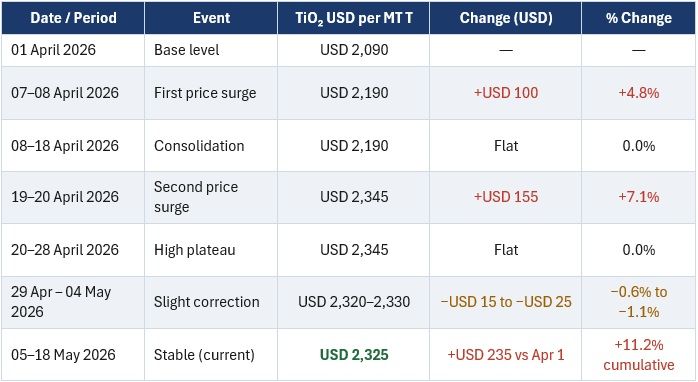
From a base of approximately $2,090 per MT on April 1, 2026, TiO₂ prices climbed in two steps to a peak of $2,345 per MT by April 20, a cumulative rise of $255 per MT (+12.2 per cent). Since, May 5, 2026, prices have stabilised at $2,325 per MT and remain at this level as of May 18th, 2026.
Concurrent with this, industrial-grade sulphur granule prices in China rose from a crisis-period baseline of approximately $555 per MT to $1,110–1,178 per MT as of May 18, 2026, an increase of 97 per cent to 109 per cent. In US dollar terms, this equates to a rise from approximately $555 per MT to $1,110–1,178 per MT, effectively more than doubling the cost of the most critical chemical input for TiO₂ production through China's dominant Sulphate Process.
Key Findings at a Glance
- Sulphate Process dominance in China (∼70–80 per cent of production) means sulphur costs pass through directly
- Current market status: Stable but elevated; downside risk if Hormuz tensions ease; upside risk from Barakah nuclear strike escalation (May 18, 2026)
Role of Sulphur in Titanium Dioxide Production
China accounts for approximately 55–65 per cent of global TiO₂ production capacity. Of the two main manufacturing routes the sulphate Process and the chloride Process Chinese producers rely predominantly (70–80 per cent of output) on the Sulphate Process, in which sulphuric acid (H₂SO₄) is the primary processing reagent. The production of sulphuric acid, in turn, depends heavily on elemental Sulphur as its principal feedstock.
A typical sulphate-process TiO₂ plant requires approximately 2–3.8 tonnes of sulphuric acid per tonne of TiO₂ produced. When sulphur prices double, the chemical input cost impact on TiO₂ is therefore highly material, a direct amplification mechanism that market participants closely monitor.
The Sulphur Supply Shock Geopolitical Origin
Elemental sulphur is primarily recovered as a by-product of petroleum refining and natural gas processing. Accordingly, any disruption to global crude oil flows simultaneously constricts sulphur supply. The escalation of the US–Iran conflict in late February 2026 and the resulting near-total closure of the Strait of Hormuz, through which around 20–22 million barrels of crude oil transited daily before the crisis, created a cascading supply shock across the petrochemical complex, including sulphur.
Chinese domestic sulphur supply is also partially supplemented by imports from the Middle East (Saudi Arabia, Kuwait, UAE), which were disrupted after February 2026 and account for more than 55 per cent. This import dependency exposed China's TiO₂ industry to an external supply shortfall precisely when domestic demand for sulphur was already firm. The result was a price trajectory that essentially doubled over twelve weeks one of the fastest and most severe sulphur market dislocations on record.
Sulphur Price Correlation to TiO₂ (Feb–May 2026)
Sulphur prices in China experienced extreme volatility between February and May 2026, directly impacting the Titanium Dioxide (TiO₂) market. Prices fell briefly from $554 per MT on 17 February to $494 per MT on February 26, before surging to $695 per MT by March 25, as the Strait of Hormuz disruption tightened supply conditions. The sharpest increase came in early April, when sulphur prices jumped to $969 per MT, up 74 per cent from the February baseline, triggering successive TiO₂ price hikes during April 7– April 8 and again on April 19 as producers passed higher costs to buyers.
Although sulphur prices eased temporarily to $862 per MT in late April, TiO₂ prices remained elevated at around $2,345 per MT, indicating strong seller price discipline. Market pressure intensified again in May, with sulphur prices rising to $1,042 per MT on May 9 and further to approximately $1,110 per MT by May 18, more than double pre-crisis levels. Despite ongoing geopolitical risks, including concerns linked to the Barakah strike escalation, TiO₂ prices stabilised at around $2,325 per MT, suggesting the market had entered a stable but elevated pricing phase.
Downstream Sector Impact Assessment
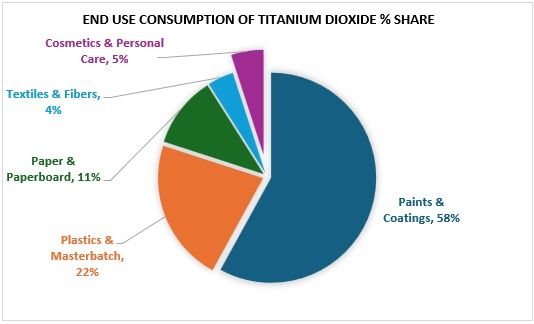
For Sellers/Producers
Maintain Selling Price Discipline: The current $2,325 per MT level is justified by cost fundamentals. Premature discounting to chase volume risks establishing unsustainable reference prices.
Communicate Cost Transparency to Customers: Share the sulphur price trajectory data with downstream buyers to justify price levels and reduce negotiation friction.
Hedge H₂SO₄ Procurement Costs where Possible: Forward contracts with sulfuric acid suppliers or sulphur procurement agreements can reduce exposure to further volatility.
Evaluate Chloride Process Investment Acceleration: In the long term, sulphur price vulnerability strengthens the case for accelerating investment in the chloride-process route, which does not use sulphuric acid and is therefore less exposed to sulphur price shocks.
 marketing@alchempro.com