



-b_Big.jpg "Tight Supply & Geopolitics Lift Global DAP Prices for Third Week")
The global Diammonium Phosphate (DAP) market witnessed another strong upward movement this week as international fertiliser prices continued to rise across key trading regions. The market remained supported by aggressive import demand from India, tight global supply conditions, and increasing geopolitical uncertainty linked to tensions involving the US and Iran. Buyers across major agricultural economies remained active in securing cargoes ahead of seasonal planting demand, while exporters-maintained firm offers due to limited spot availability. Rising freight costs and energy market volatility further strengthened bullish sentiment throughout the phosphate fertiliser market.
Week-on-Week Price Strong Market Momentum
The increase in DAP prices in both import and export markets. Asia Cost and Freight (CFR) India DAP prices increased from approximately $0.860/kg during the previous week to $0.932/kg in the current week, representing a week-on-week increase of nearly 8.37 per cent. Similarly, Saudi Arabia Free on Board (FOB) DAP prices increased from around $0.845/kg to $0.905/kg, reflecting a weekly rise of approximately 7.10 per cent. The strong price increase clearly indicates tightening global availability and strong buyer competition for limited cargoes in the international market. The shutdown of the Strait of Hormuz disrupted approximately 25 per cent urea export capacity and nearly 33 per cent of DAP export capacity originating from the Gulf region. For global prices reach out to ALCHEMPro Team.
Indian Demand Continues to Drive Global DAP Trade
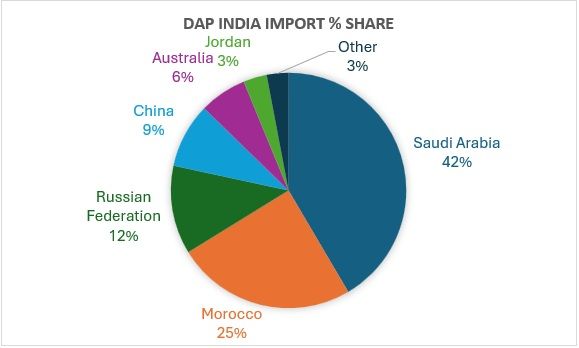
India remained the dominant force influencing global DAP trade during the week as importers accelerated purchases ahead of the Kharif sowing season. Large procurement tenders by Indian buyers significantly tightened spot market supply and increased competition among importing nations. Suppliers from Saudi Arabia, Morocco, Russia, Jordan, Egypt, and the US actively participated in Indian demand requirements, but the availability of prompt cargoes remained limited. As one of the world’s largest fertiliser-consuming countries, India’s aggressive buying activity has continued to support higher international DAP prices and strengthened seller confidence in maintaining elevated offer levels.
US-Iran Geopolitical Tensions Intensify Market Volatility
The ongoing geopolitical tensions involving the US and Iran continued to create uncertainty in global fertiliser and energy markets. Concerns surrounding the Strait of Hormuz, one of the world’s most important shipping routes for energy products and fertilisers, increased fears regarding possible disruptions in maritime trade flows. The Gulf region plays a critical role in supplying sulphur, ammonia, phosphates, and other fertiliser feedstocks to global markets. Any disruption to shipping operations or export logistics in this region directly impacts fertiliser production costs, freight availability, and global supply chains. As tensions escalated, shipping insurance premiums and transportation costs increased further, contributing to higher CFR fertiliser prices in importing countries.
Tight Global Supply Continues to Pressure Buyers
Global DAP supply conditions remained constrained due to reduced export availability from several producing regions. China’s tighter phosphate export controls and lower spot market participation continued to reduce product availability for international buyers. At the same time, producers in other regions maintained cautious sales strategies due to rising raw material costs and expectations of further price increases. Seasonal agricultural demand in Asia and Latin America also increased competition for available material, preventing any significant easing in the market. Traders reported that suppliers maintained firm pricing positions because global inventory levels remained relatively tight.
Asia CFR India prices reached approximately $0.932/kg, while Saudi Arabia FOB values increased to nearly $0.905/kg. India recorded a weekly increase of approximately 8.37 per cent, whereas Saudi Arabia experienced a gain of nearly 7.10 per cent during the same period. Freight costs also moved upward due to shipping risks and limited vessel availability. Market sentiment remained strongly bullish as buyers continued active procurement activity amid concerns regarding future supply availability.
Major Importing Countries Face Rising Cost Pressure
Several major agricultural economies experienced growing pressure from rising DAP prices during the week. India remained highly vulnerable because of its heavy dependence on imported phosphatic fertilisers and rising subsidy burdens linked to higher international prices. Countries such as Pakistan, Bangladesh, Indonesia, Japan and others experienced additional cost inflation due to expensive Gulf-origin cargoes and rising freight rates. Meanwhile, European agricultural markets witnessed higher farming input costs due to the combined impact of elevated energy prices and fertiliser market volatility.
Agricultural End Uses Keep DAP Demand Strong
DAP continued to remain one of the world’s most important phosphate fertilisers because of its high nutrient concentration and effectiveness in improving crop productivity. Farmers widely use DAP during the initial planting stage to support root development, seed formation, flowering, and overall plant growth. The fertiliser is heavily consumed in rice cultivation, wheat farming, corn production, soybean plantations, sugarcane cultivation, cotton farming, and fruit and vegetable agriculture. Strong agricultural demand across Asia and Latin America continued to support robust international consumption levels throughout the week.
Raw Material Costs Continue to Increase Production Expenses
DAP production remained under pressure due to rising prices of key feedstocks such as sulphur, phosphoric acid, and natural gas. Energy market volatility caused by geopolitical tensions in the Middle East added further uncertainty to production economics for fertiliser manufacturers globally. Rising upstream costs forced producers to maintain firm pricing strategies to protect operational margins. Industry participants indicated that sustained increases in feedstock prices could continue supporting elevated fertiliser values in the near term.
The DAP market continued to show an upward trend, driven by limited supply availability and ongoing geopolitical concerns that heavily influenced market sentiment. Industry stakeholders believe global prices are likely to stay high unless there is a notable improvement in supply conditions or a reduction in geopolitical instability. Key factors being closely watched include developments in US–Iran relations, shipping activity through the Strait of Hormuz, China’s phosphate export policies, India’s import requirements, fluctuations in freight costs, and changes in global energy prices. If supply constraints persist while seasonal agricultural demand remains firm, DAP prices are expected to keep rising in the coming weeks.
 marketing@alchempro.com