


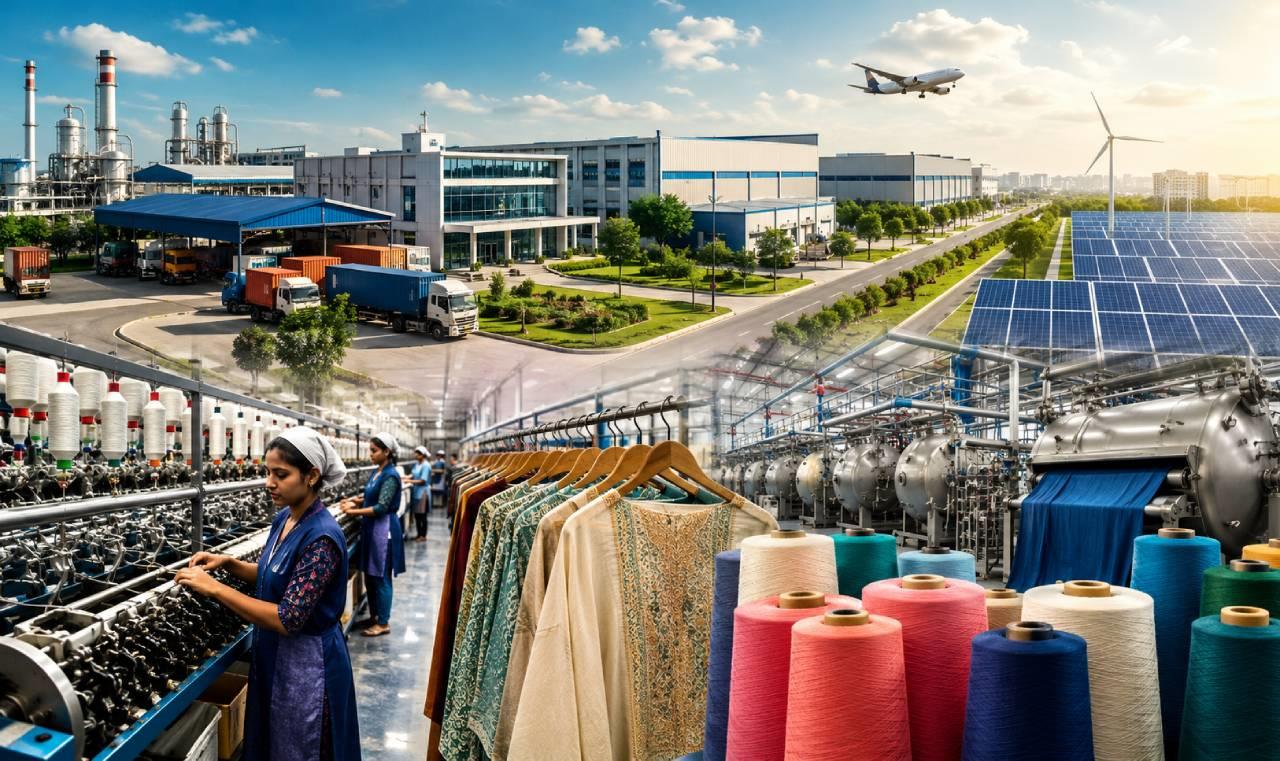
The textile industry has always been one of the strongest pillars of India’s economy, contributing significantly to employment generation, exports, cultural preservation, and rural development. In the present era of globalisation and technological advancement, the textile sector is rapidly moving towards integrated manufacturing systems, sustainable production, and innovation-driven growth. Textile parks are emerging as a transformative force in this direction, opening a new chapter for the textile and apparel industry.
Textile parks are specially developed industrial zones where spinning, weaving, dyeing, garment manufacturing, processing, packaging, logistics, and export facilities are available within a single integrated location. These parks provide world-class infrastructure, modern machinery, common utilities, and better supply-chain management systems, helping industries reduce operational costs and improve global competitiveness.
The Government of India has introduced several schemes such as the Scheme for Integrated Textile Parks (SITP), PM MITRA (Pradhan Mantri Mega Integrated Textile Region and Apparel) parks, and the National Technical Textiles Mission (NTTM) to strengthen India’s textile infrastructure and position the country as a global textile manufacturing hub.
PM MITRA Parks: Transforming India’s Textile Landscape
One of the most ambitious initiatives in recent years is the PM MITRA scheme launched by the Government of India in 2021. Under this scheme, seven mega textile parks are being developed across Uttar Pradesh, Gujarat, Tamil Nadu, Karnataka, Maharashtra, Telangana, and Madhya Pradesh.
The PM MITRA parks are designed on the concept of “Farm to Fibre to Factory to Fashion to Foreign,” creating fully integrated textile manufacturing ecosystems. These parks will include modern facilities such as plug-and-play industrial infrastructure, common effluent treatment plants, logistics and warehousing centres, worker housing, skill development institutes, research laboratories, and sustainable energy systems.
According to Ministry of Textiles reports (2024–25), these mega parks are expected to attract investments worth thousands of crores, generate lakhs of employment opportunities, and significantly strengthen India’s textile exports.
Uttar Pradesh Emerging as a Major Textile Hub
Uttar Pradesh is rapidly becoming one of India’s leading textile investment destinations. Through the Uttar Pradesh Textile and Garmenting Policy–2022, the state government is promoting textile manufacturing, apparel industries, technical textiles, and handloom-based entrepreneurship.
PM MITRA Park at Lucknow–Hardoi Border: One of the most significant upcoming projects is the PM MITRA park being developed near the Lucknow–Hardoi border. Spread across nearly 1,000 acres, including approximately 730 acres in Lucknow district and 270 acres in Hardoi district, the park is strategically located near Malihabad with strong connectivity to airports, highways, and railway networks.
The project is expected to attract investments exceeding ₹10,000 crore and generate nearly 1–3 lakh direct and indirect employment opportunities. The integrated textile ecosystem will include spinning, weaving, processing, dyeing, garment manufacturing, warehousing, logistics, and export facilities under one industrial zone.
The development of this textile park is expected to strengthen the ‘Make in India’ initiative by reducing dependence on imported textile products and machinery while boosting domestic manufacturing capacity.
India’s First Textile Machine Park in Uttar Pradesh
Another landmark initiative is the proposed Textile Machine Park near Kanpur in Chaparghata village. To be developed across approximately 875 acres under the Public-Private Partnership (PPP) model, this project is considered India’s first dedicated textile machinery manufacturing park.
The park aims to manufacture advanced textile machinery domestically, including circular knitting machines, flat knitting machines, printing machines, sewing machines, and technical textile equipment that are currently imported from countries such as China, South Korea, Taiwan, and European nations.
Government reports suggest that more than 200 industrial units may be established under this project, generating employment opportunities for nearly 150,000 people. Textile machinery exports worth approximately ₹30,000 crore (~$3 billion) are also expected in the future. This initiative represents a major step towards technological self-reliance and industrial modernisation in the Indian textile sector.
Expansion of Private Textile Parks
Along with government-supported mega parks, several private textile parks are also being established in districts such as Gorakhpur, Mau, Bhadohi, Aligarh, Baghpat, and Shamli. The Lonex Textile Park in Shamli is among the first major private textile parks under development in Uttar Pradesh. These parks are expected to strengthen MSMEs, garment manufacturing units, and traditional textile clusters by providing better infrastructure, branding support, export connectivity, and modern processing facilities. Regional textile crafts such as Chikankari of Lucknow, Banarasi weaving of Varanasi, carpet weaving of Bhadohi, and handloom industries of Mau can greatly benefit from these integrated textile ecosystems.
Employment and Economic Opportunities
Textile parks are creating enormous economic opportunities by developing integrated manufacturing ecosystems. These parks support employment generation for weavers, tailors, designers, textile engineers, machine operators, artisans, and rural youth. Women artisans and self-help groups particularly benefit from textile-sector employment and entrepreneurship opportunities. According to textile industry estimates, India’s textile market is expected to reach nearly $350 billion by 2030, creating substantial demand for skilled manpower and industrial infrastructure.
Sustainable Manufacturing and Green Textile Infrastructure
Modern textile parks are increasingly focusing on sustainable and environmentally responsible manufacturing systems. Many upcoming parks are integrating:
- Solar energy systems
- Rainwater harvesting
- Wastewater recycling
- Zero liquid discharge systems
- Eco-friendly dyeing technologies
- Solid waste recycling units
These sustainable practices help reduce water pollution, chemical contamination, and textile waste generation while promoting green industrial development. Sustainable textile parks also align with India’s growing focus on circular fashion, low-carbon manufacturing, and eco-friendly textile production systems.
Opportunities for Students, Researchers, and Start-ups
The expansion of textile parks is creating new opportunities for textile students, researchers, fashion designers, entrepreneurs, and start-ups. Emerging fields such as technical textiles, smart fabrics, digital fashion, AI-based apparel systems, textile recycling, and sustainable dyeing technologies are gaining rapid importance.
Educational institutions and textile universities can collaborate with textile parks through industrial training programmes, internships, research projects, innovation centres, and skill development initiatives. Such collaborations can help create a future-ready workforce for India’s expanding textile and apparel sector.
Despite their enormous potential, textile parks still face certain challenges including environmental management, shortage of skilled workforce, high capital investment, technological upgradation, and global competition. However, with strong government support, sustainable planning, and industry-academia collaboration, textile parks can become major centres of industrial growth and innovation.
The future textile industry will increasingly focus on:
- Green textiles
- Circular fashion systems
- Technical textiles
- Smart wearable fabrics
- Sustainable manufacturing
- Digital textile technologies
Textile parks are expected to become the foundation of this industrial transformation.

 marketing@alchempro.com