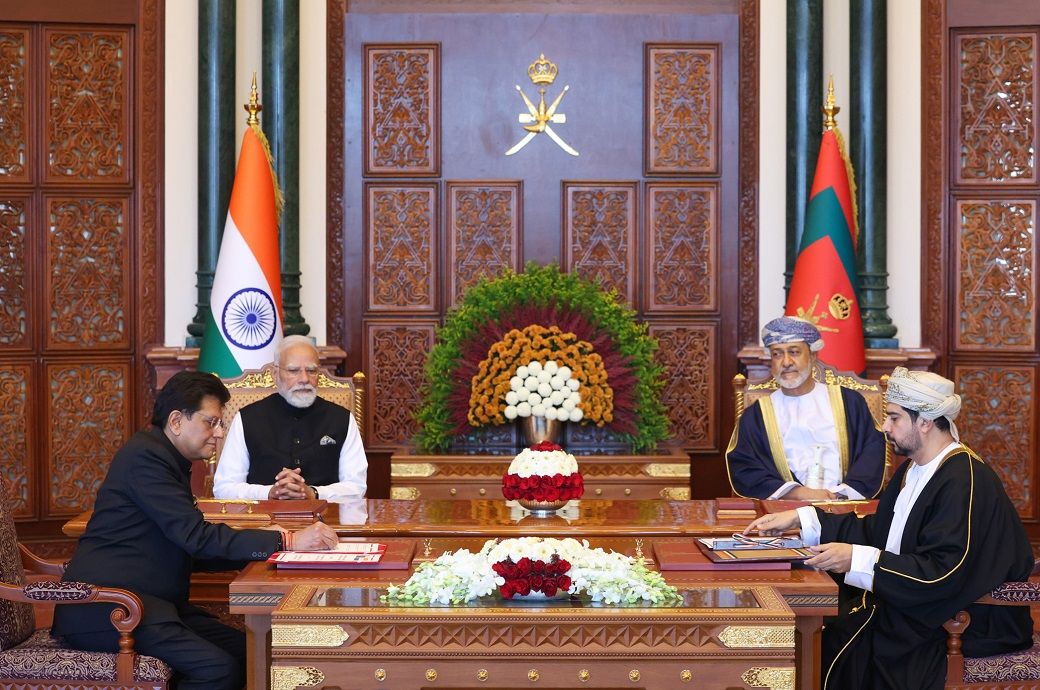
This is the first bilateral agreement that Oman has signed with any country since the one with the United States in 2006.
The agreement was signed by Indian Commerce and Industry Minister Piyush Goyal and Oman’s Minister of Commerce, Industry and Investment Promotion Qais bin Mohammed Al Yousef in the presence of visiting Prime Minister Narendra Modi and Sultan of Oman Haitham bin Tarik.
Bilateral trade between the two countries stands at over $10 billion, with strong potential for expansion under the CEPA framework, a release from the Indian Ministry of Commerce and Industry said.
This is the second free trade agreement that India signed in the last six months after the one with the United Kingdom. It is a part of strategy to sign trade agreements with developed economies that are not competing with India's labour-intensive interests and provide opportunities for Indian businesses, the release said.
The CEPA secures unprecedented tariff concessions for India from Oman. Oman has offered zero-duty access on 98.08 per cent of its tariff lines, covering 99.38 per cent of India’s exports to the country.
All major labour-intensive sectors, including textiles, leather, footwear, sports goods, plastics, furniture, agricultural products, engineering products, receive full tariff elimination. Out of the above, immediate tariff elimination is being offered on 97.96 per cent tariff lines.
India is offering tariff liberalisation on 77.79 per cent of its total tariff lines that covers 94.81 per cent of India’s imports from Oman by value. For the products of export interest to Oman and that are sensitive to India, the offer is mostly a tariff-rate quota (TRQ)-based tariff liberalisation.
To safeguard its interest, sensitive products have been kept in the exclusion category by India without offering any concessions, especially agricultural products, including dairy, tea, coffee, rubber, and tobacco products; gold and silver bullion, jewellery; other labour-intensive products such as footwear, sports goods; and scrap of many base metals.
India’s services sector will also see wide-ranging benefits. A major highlight of the CEPA is the enhanced mobility framework for Indian professionals.
Provisions in the agreement also address non-tariff barriers persisting despite tariff concessions, limiting real market access.
ALCHEMPro News Desk (DS)
Receive daily prices and market insights straight to your inbox. Subscribe to AlchemPro Weekly!
 marketing@alchempro.com