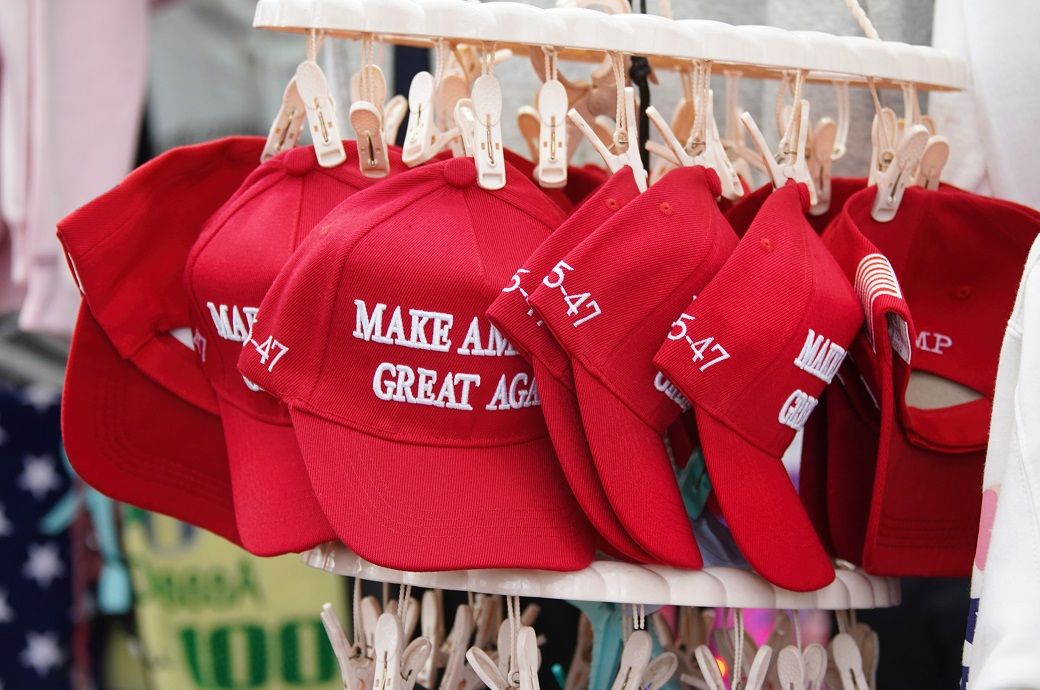
The supply chain behind it, however, is split. Official merchandise is promoted as American-made and channels revenue to campaign and party structures, while a parallel, largely unregulated market produces low-cost alternatives in China and ships them through global e-commerce platforms.
Official and unofficial pipelines
The official merchandise pipeline is straightforward. The Trump campaign has long advertised caps as ‘Proudly Made in America’, with production centred at Cali-Fame in California and fulfilment managed by Ace Specialties in Louisiana. By mid-2016, the campaign had already paid the Los Angeles-based hat maker about $1.5 million. Caps sold through the Trump Store or WinRed are priced at a premium, typically between $30 and $55, reinforcing their status as sanctioned items. Scrutiny has nonetheless followed. The Federal Trade Commission requires that products marketed as ‘Made in USA’ meet an “all or virtually all” domestic standard, and questions have arisen over whether imported inputs such as textiles or dyes can fully meet that bar.
Running alongside this channel is a vast unofficial market. Independent sellers source merchandise from Chinese factories where hats wholesale for as little as $2 and printed T-shirts appear on platforms within hours of major political events. Reuters has documented banners on Chinese production lines and analysts have found that China-based sellers dominate online political paraphernalia listings. This system is fast, opportunistic and largely outside formal oversight.
Parallel economies
The economics differ sharply. Official caps, retailing at $45 or more, feed directly into campaign and party fundraising. By 2019, about one million had been sold. Trump Organization sales of political merchandise grew from roughly $520,000 in 2018 to more than $3 million in 2023, illustrating how campaign branding blurred into a retail operation.
Unofficial products, by contrast, sustain networks of roadside vendors, wholesalers and global online sellers. Vendors in the US travel between rallies to set up temporary stalls, while wholesalers such as MAGA Mall supply conservative groups nationwide. These tiers create a parallel economy with its own logistics and margins. Precise figures are elusive, but customs seizures and marketplace tracking suggest that unofficial sales may rival, or even surpass official volumes.
Labour and materials highlight the contradictions. Many official caps are stitched in California by Latino immigrant workers, while unofficial products flow from Chinese workshops where production is driven by order volume, not politics. The rhetoric of economic nationalism sits uneasily atop these global realities, though this tension has little impact on sales. Research suggests that for consumers, the symbolic value of the MAGA red cap outweighs concern over inputs, origins or labour conditions.
Monetising identity
Policy frameworks shape this ecosystem indirectly. There are no bespoke subsidies for MAGA manufacturers, but broad tax changes under the 2017 Tax Cuts and Jobs Act and subsequent legislation have reduced effective rates for US producers. Tariffs on Chinese goods function as a form of protection, raising costs for foreign-made merchandise. Yet they also increase prices for US buyers and for domestic manufacturers reliant on imported textiles, dyes or hardware. Intellectual property enforcement presents another layer—while official channels rely on trademark protection, counterfeit or unofficial goods continue to appear at roadside stalls and online marketplaces with limited effective deterrence.
The durability of this merchandise economy points to broader trends. Political movements increasingly monetise identity through retail, converting loyalty into product sales. Similar dynamics were seen in Barack Obama’s 2008 campaign and Bernie Sanders’ 2016 run, but the scale and longevity of MAGA’s retail arm are exceptional. Whether it can sustain momentum in a post-Trump era is an open question. Brand loyalty may persist, but much of the ecosystem depends on Trump as a living political figure and on news-driven demand.
Lessons to be learned
For the wider apparel sector, the case is instructive. It shows how ‘Made in USA’ claims are difficult to guarantee in multi-tiered supply chains, how tariffs can protect and penalise simultaneously and how consumer demand can transform political identity into merchandise at speed. The MAGA brand is therefore less an anomaly than a particularly vivid case study in how politics, retail and global supply chains intersect.
ALCHEMPro News Desk (IL)
Receive daily prices and market insights straight to your inbox. Subscribe to AlchemPro Weekly!
 marketing@alchempro.com