PFAS are commonly referred to as ‘forever chemicals’ because they break down only very slowly, accumulate in the environment and in living organisms, and can cause harm there. Short- and ultrashort-chain PFAS with two to seven carbon atoms pose a particular technical challenge for sewage treatment plants and waterworks: they adsorb poorly on activated carbon and bind ustably in many ion exchange resins, especially when competing anions are present.
Specifically designed to treat wastewater contaminated with short-chain PFAS, LANXESS developed and launched the monodisperse selective resin Lewatit MDS TP 108 (Mono Dispers Small) in 2024. Compared with conventional ion exchange resins, its resin beads have a diameter approximately one-third smaller. This results in significantly higher capacity and therefore longer service life. Thanks to faster exchange kinetics, the MDS resin maintains its performance even at high flow rates.
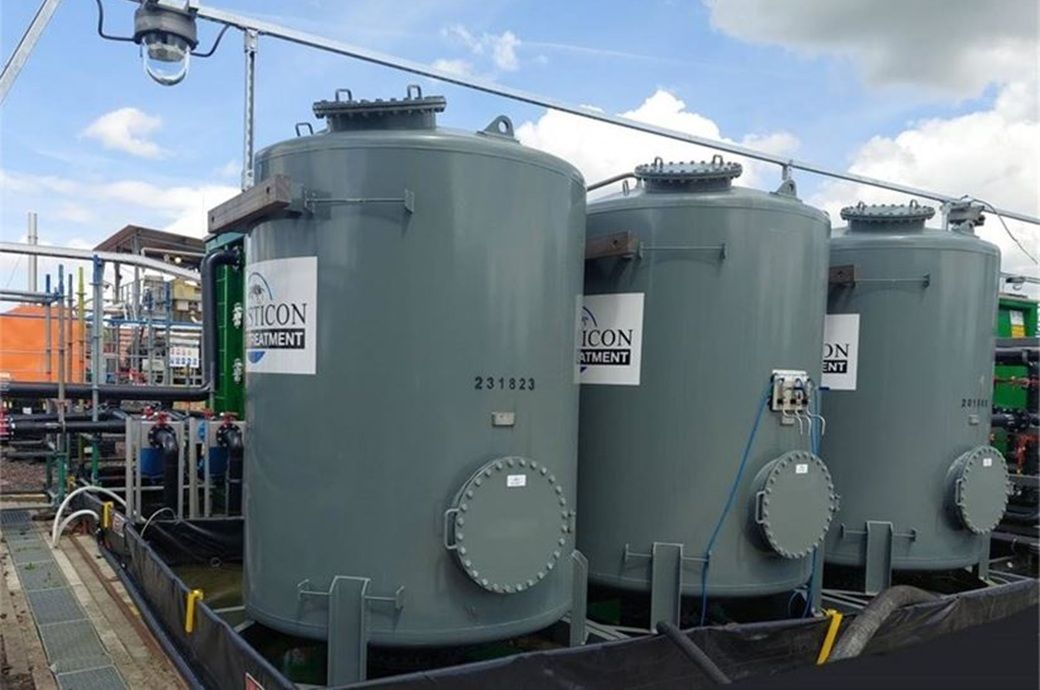
Chemours employs a three-stage purification process. In the first step, reverse osmosis produces a PFAS-depleted permeate and a small-volume, PFAS-enriched concentrate. In the second step, activated carbon filters bind the long-chain PFAS from the concentrate – a necessary preparatory step, since these compounds would otherwise occupy the selective resin and block it for short-chain PFAS. In the third step, a cascade of three Lewatit MDS TP 108 vessels – one primary filter and two polishing filters – removes the short-chain PFAS with two and three carbon atoms.
“Our tailored ion exchange resins have bound more than 99.9% of all fluorinated organic compounds from the wastewater. After use, they are incinerated at high temperatures to destroy the PFAS,” explains Björn Dinges, Application Technology Manager at LANXESS.
The complete water treatment plant, including specialized operating procedures for all subsystems, was designed and supplied by engineering partner Logisticon Water Treatment B.V., Groot-Amers, Netherlands. At Chemours, the plant has been in regular operation since mid-2025 following a multi-month trial period and is making a significant contribution to sustainably reducing process emissions of fluorinated organic compounds at the site while meeting strict regulatory requirements.
ALCHEMPro News Desk (JP)
Receive daily prices and market insights straight to your inbox. Subscribe to AlchemPro Weekly!
 marketing@alchempro.com