Foreign Minister Sergei Lavrov stepped off his plane in a sweatshirt stamped ‘CCCP’ (USSR in English) while Kremlin outlets boasted that the press corps had been served Chicken Kyiv en route. A sweatshirt and a menu are ordinary things until they are not. Soviet letters asserted a historical claim in block print to Ukraine, while ‘Kyiv’ turned into a culinary sneer, recasting the nation’s capital as a punchline.
Zelenskyy’s new look
Within days, Volodymyr Zelenskyy arrived in Washington for a follow-on summit in a French-style army jacket and coordinated trousers by Ukrainian designer Viktor Anisimov—a deliberate evolution from his military fatigues.
Anisimov stressed that this shift had been in the works since January and was not a reaction to earlier criticism of Zelenskyy’s attire in the White House. Anisimov said his aim was to nudge the Ukraine president’s image “towards a more civilian style, while still preserving the military reference.”
The jacket itself was not a classic suit at all, but a structured field garment in military canvas with four patch pockets—the visual residue of a uniform, reinterpreted for diplomacy. In other words, even as policy talk remained hazy, the clothes were sharpening the story—Ukraine signalling sovereignty and durability while easing towards peacetime posture without surrendering its wartime claim to solidarity.
Turning arguments into images
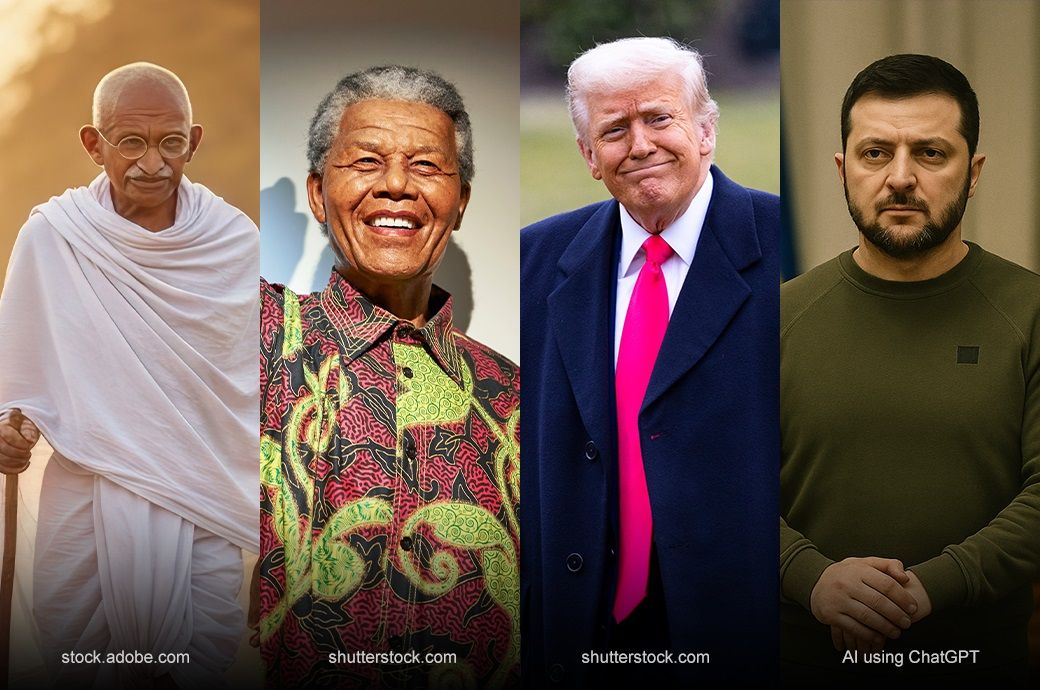
Snap judgments are much faster than policy, and clothing acts like political speech by compressing arguments into images. Gandhi’s homespun khadi translated self-rule into texture, while China’s Zhongshan tunic stitched a narrative of unity into a single, disciplined silhouette.
Volodymyr Zelenskyy’s olive knits and fleeces similarly make a statement of solidarity and even a quiet navy business suit speaks in shorthand about continuity and competence.
None of this is tailoring trivia. It is the practical language of persuasion—which signals leaders choose, which emotions they aim to spark and how deftly they tune those signals to move an audience.
Politicians understand this. They are not merely getting dressed but loading a visual script calibrated to the room and the moment. However varied the script, the subliminal objective is steady—help viewers feel safe, represented and proud. Different garments are different routes to those three feelings.
Tailored authority
Britain standardised the template for the modern suit and by the late 19th century the lounge suit—seasonless navy, boardroom charcoal—had become the portable uniform of office. The craft hidden inside a well-made jacket matters not because voters study pad stitches, but because structure photographs as continuity. Under lights, that controlled drape reads as institutional spine.
Washington still adheres to this even when it pretends to bicker about ties. Red or blue neckwear is mood music. What actually jars are breaks in the continuity story. Barack Obama’s tan suit detonated a news cycle because it swapped navy’s courtroom gravity for summer ease, turning a policy moment into a debate about tone. The paradox is that as a most ‘invisible’ tone, navy persuades best, keeping attention on the message while broadcasting competence.
Virtue or austerity
India perfected a counter image, choosing virtue over polished power. Gandhi’s khadi, with its visible slubs and open weave, translated boycott and self-reliance into tactile politics. After India’s independence, the white-on-white kurta-pyjama and dhoti carried that idea forward—purity, frugality, proximity to the village. On a rally stage, a white kurta acts like a lighthouse in a sea of colour, its moral legibility survives distance and glare.
But austerity is also performance, and breaks in the performance sting. When Rahul Gandhi wore a Burberry puffer during a cold-weather push, critics priced the jacket and accused him of elite indulgence. He pointed out that it was a gift, but the damage was done.
Prime Minister Narendra Modi’s monogrammed bandhgala meanwhile startled voters unused to overt personal logos in Indian politics. He then auctioned the garment for a public cause, heading off a backlash—the monograms declared singularity while the auction claimed civic virtue.
Local belonging
Other leaders have also bypassed the suit and built authority by rooting themselves in their locality. Nelson Mandela’s Madiba shirts—loose, long-sleeved silks in saturated batiks—rejected colonial stiffness while celebrating South African design. Across Latin America and the Caribbean, the guayabera functions as climate-rational formality, while in the Philippines, the barong Tagalog—sheer piña or abacá with an embroidered chest panel—makes a parallel case. To the camera, these garments achieve the same diplomatic lift as a suit, but with a different emotional charge—'we belong here on our own terms’.
The continuity costume
In US politics, the suit remains civic glue. Flag pins, worsted wool and discrete shoes form the continuity costume. Break it and you need cover. That is why Mark Zuckerberg, who helped mainstream Silicon Valley’s hoodie-and-jeans uniform, wore Washington’s navy when he faced Congress in 2018. He understood the room. The same hoodie that triggered ‘Hoodiegate’ on a 2012 IPO roadshow—bankers read immaturity—would have been disastrous in a Senate hearing. Garments do not change meaning, rooms do.
Meanwhile, American elites outside government speak another dialect. In finance and tech, the fleece or puffer vest became a tribe marker—practical, outdoorsy competence that quietly signals access to certain offices and options. Think of Jeff Bezos and the broader vest aesthetic that brand managers tried, and failed, to regulate. The pushback only cemented the vest as class code.
Then came DOGE-time in 2025, when Elon Musk briefly stepped into government corridors as the face of a ‘Department of Government Efficiency’. Whatever one thinks of the initiative, the clothes read clearly. Black hats bearing the DOGE logo, novelty T-shirts and meme-ready logos collided with rooms built for navy suiting. The choice was intentional. In the same way a chalk stripe says Parliament, a meme T-shirt in the Roosevelt Room declares disruption as the doctrine.
Telling the story
Returning to Alaska. If you tracked only the statements, you heard fog—hedged talk of guarantees, open questions about territory, promises of further meetings. If you watched the clothes, you saw two scripts.
Washington staged continuity and command with the architecture of an air base and the vocabulary of the presidential suit. Moscow staged grievance-as-swagger with a single sweatshirt, pinning the frame to Soviet nostalgia and trolling through a menu. That is why the sweatshirt landed. It was not clever, it was obvious at a glance, and it welded an old story to a live negotiation. The caution for Western capitals is simple—do not donate stage sets on which your opponent’s costume tells the better story.
ALCHEMPro News Desk (IL)
Receive daily prices and market insights straight to your inbox. Subscribe to AlchemPro Weekly!
 marketing@alchempro.com