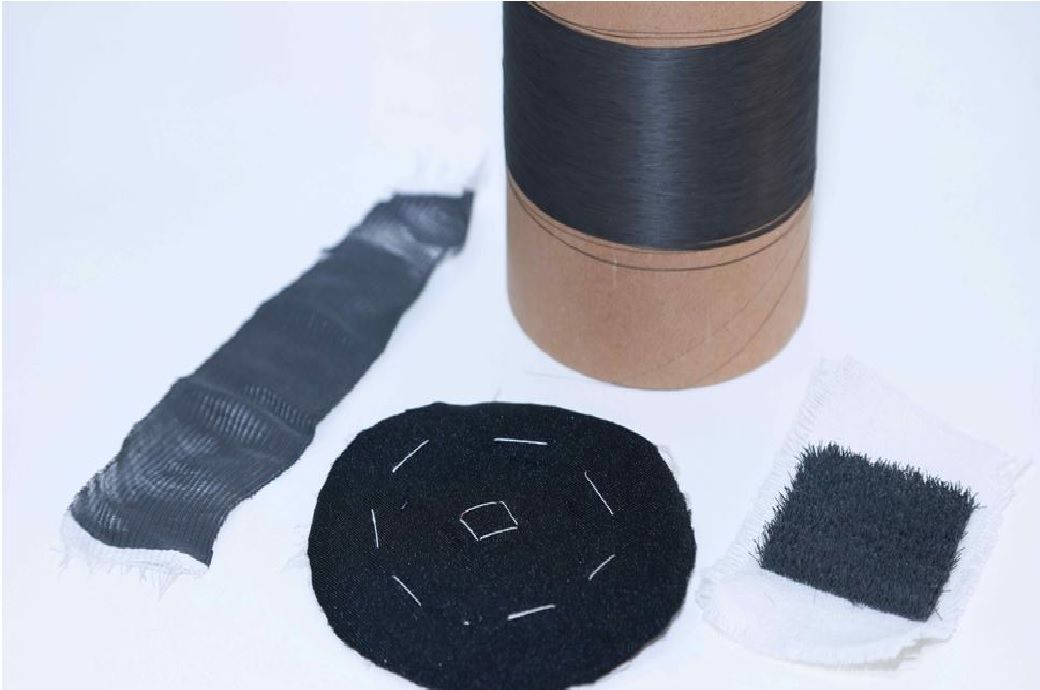
Traditional magnetorheological materials have long faced two major drawbacks: heavy magnetic powders and the potential health risks posed by high-strength magnetic fields to the human body. Prof. Tao Xiaoming, director of the PolyU Research Institute for Intelligent Wearable Systems, Vincent and Lily Woo, professor in textiles technology and chair professor of Textile Technology of the School of Fashion and Textiles, who led the research, elaborated, “The core objective of our research team is to overcome the application limits of traditional magnetorheological technology, extending it to fibre form, and enabling precise intelligent modulation while remaining compatible with textile properties such as softness and breathability.”
The research team fabricated soft magnetic polymer composite fibres – just 57 micrometers in diameter – by uniformly dispersing magnetic powders in a plastic material (a low-density polyethylene matrix). These fibres not only achieve precise control under low-strength magnetic fields but also solve the problem of heavy magnetic powders. Furthermore, they can be spun into yarns and multi-layer fabrics to realise large-area, controllable deformation.
Unlike traditional smart materials that respond to scalar stimuli such as voltage, current or temperature, these in-house-developed magnetorheological textiles offer unique directionally controllable responses, enabling the development of the following three innovative fabric materials, the study said.
“The key breakthrough of this research lies in converting traditional rigid magnetic devices into flexible alternatives. This success can be extended to the development of hard magnetic fibre materials, laying a foundation for the next generation of soft robotics, electromagnetic devices and wearable technologies,” explained Xiaoming.
Regarding the prospects for industrialisation, Dr PU Junhong, assistant professor (research) of the School of Fashion and Textiles, said, “From raw material selection to processing technology, we have taken industrialisation needs into consideration. We adopt commodity-grade, mass production-ready raw materials and mature processing techniques, paving the way for rapid translation in fields such as food production, medical rehabilitation and metaverse interaction.”
ALCHEMPro News Desk (RR)
Receive daily prices and market insights straight to your inbox. Subscribe to AlchemPro Weekly!
 marketing@alchempro.com