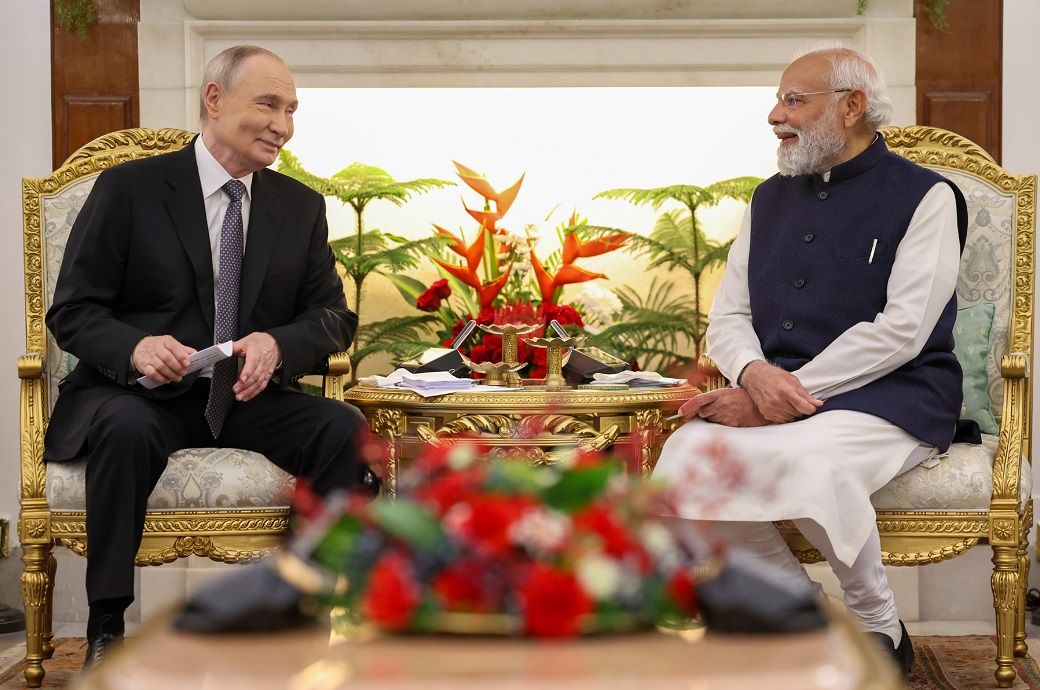
Indian Prime Minister Narendra Modi and President Putin reaffirmed that their eight-decade partnership—defined by trust, mutual respect and strategic convergence—remains an anchor of stability amid global geopolitical uncertainty.
PM Modi said the new roadmap will make bilateral trade “more diversified, balanced and sustainable,” while opening avenues for co-production, co-innovation and deeper industrial collaboration. Central to this ambition is the ongoing negotiation of a Free Trade Agreement between India and the Eurasian Economic Union, expected to unlock new export potential once concluded.
A key highlight was the adoption of ‘Programme 2030’, which prioritises balanced trade, smoother payment mechanisms, removal of tariff and non-tariff barriers, and greater logistics efficiency. Both sides are working to strengthen settlements in national currencies and explore interoperability between payment systems and digital currency platforms. The revised bilateral trade target of $100 billion by 2030 was reaffirmed, the two countries said in a joint statement.
Energy security—long a backbone of the partnership—received new emphasis. The two countries committed to broadening collaboration across oil, gas, petrochemicals, underground coal gasification, LNG and LPG infrastructure, and nuclear energy. Russia and India agreed to fast-track the delivery schedules for equipment and fuel for the Kudankulam Nuclear Power Plant and continue discussions on a second nuclear site in India.
Connectivity emerged as a top priority, with renewed momentum for the International North–South Transport Corridor (INSTC), the Chennai–Vladivostok maritime corridor and the Northern Sea Route. An MoU on training Indian seafarers for polar operations is expected to strengthen Arctic cooperation and create new employment opportunities.
Deepening engagement in the Russian Far East and the Arctic was reaffirmed, supported by a separate cooperation programme for 2024–2029. Sectors like agriculture, energy, manpower, mining, diamonds, pharmaceuticals and maritime transport will be focus areas.
The leaders also highlighted the growing importance of critical minerals for clean energy and high-tech manufacturing. Both sides pledged stronger collaboration in exploration, processing and recycling technologies, alongside plans for joint ventures in fertilizers and long-term supply arrangements.
People-centric initiatives formed a major segment of the discussions. India recently opened new consulates in Yekaterinburg and Kazan, while Russia will soon benefit from a free 30-day e-tourist visa and group visa scheme. New agreements on skilled manpower mobility, joint vocational training and expanded academic exchanges aim to create deeper societal linkages.
Modi and Putin reiterated longstanding cooperation on counter-terrorism, condemned recent attacks in India and Russia, and called for zero-tolerance policies on extremism. They also reaffirmed close alignment at key multilateral platforms including the UN, G20, BRICS and SCO, with Russia reiterating support for India’s bid for permanent membership of the UN Security Council.
From civil nuclear technology and space cooperation—including joint work on rocket engines and human spaceflight—to expanding defence co-development and co-production under Make in India, the summit underscored the multi-dimensional depth of the India–Russia partnership.
Putin thanked Modi for the warm hospitality and invited him to Russia in 2026 for the next annual summit, marking another step in the steady evolution of a relationship both countries describe as “special and privileged”.
ALCHEMPro News Desk (KD)
Receive daily prices and market insights straight to your inbox. Subscribe to AlchemPro Weekly!
 marketing@alchempro.com