



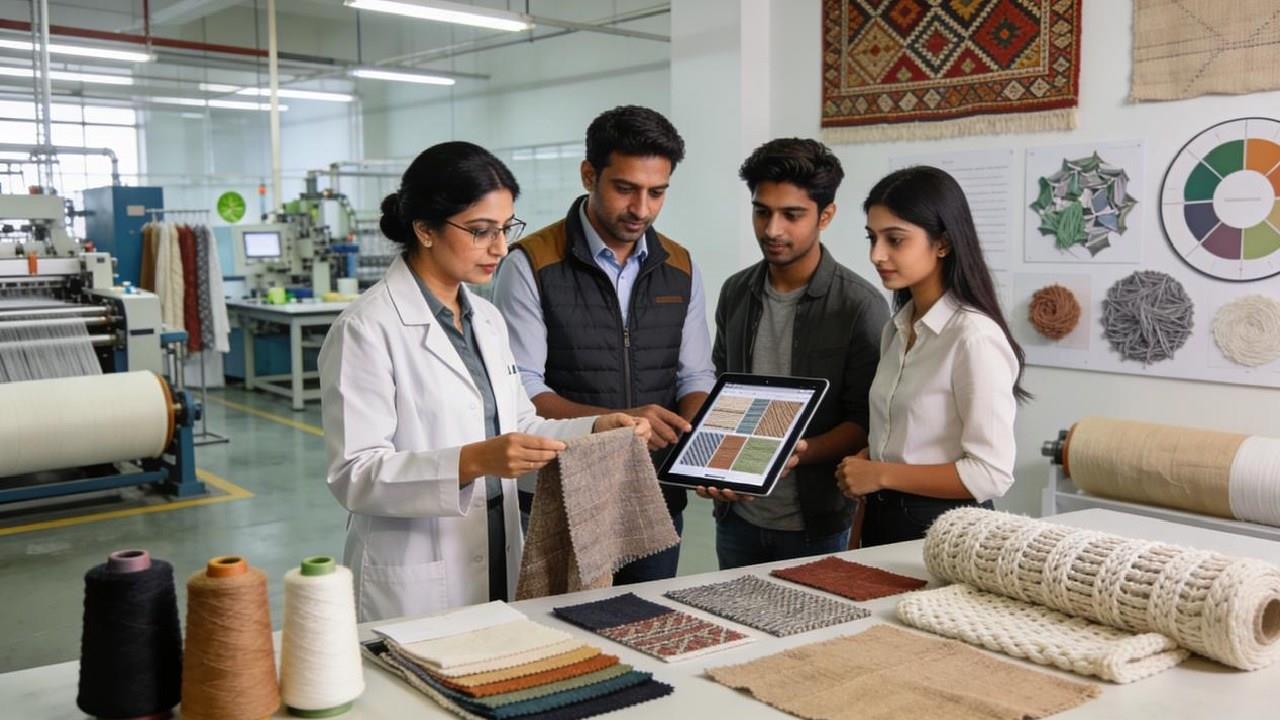
India’s textile industry has always thrived on the knowledge its people carry—the weaver who reads a loom by sound, the dyemaster who adjusts chemistry by touch, the merchandiser who anticipates a season before the trend sheets arrive. That embedded, earned expertise is real and should be celebrated. And yet, there is a growing conversation in the sector about what more becomes possible when that hard-won experience meets the kind of research being done in India's universities and technical institutes. The good news is that the foundations for exactly this kind of collaboration are already being laid.
India's textile and apparel sector contributes approximately two per cent of the country’s Gross Domestic Product and 11 per cent of manufacturing Gross Value Added, employing over 45 million people directly, making it the second-largest employer in the country after agriculture. (PIB, 2025a). India’s domestic market was valued at $225 billion in 2025, with strong growth momentum towards $350 billion by 2030 (IBEF, 2026). The government has set a textile export target of $100 billion by 2030, up from $35.87 billion in 2023-24 (Ministry of Textiles, Government of India, 2024). These ambitions are backed by policy, funding, and a genuine national commitment to make the sector more competitive. The question is how the full potential of that commitment can be realised, and collaboration between industry and education is a central part of the answer.

The Opportunity in the Numbers
India's Gross Expenditure on Research and Development (GERD) as a share of GDP stood at 0.64 per cent in 2020-21 and building that investment over time is recognised as a national priority (DST, 2022). Comparable economies invest significantly more: South Korea at 4.2 per cent, the United States at 2.8 per cent, China at 2.1 per cent (EAC-PM, 2019), and the direction India is moving towards is clear. Increasing private sector participation in R&D, which currently stands at around 36.4 per cent of total R&D expenditure, is one of the key levers available (PIB, 2025b).
One of the most telling indicators of what increased research engagement could unlock is the technical textiles market. Technical textiles, i.e., performance fabrics used in medicine, agriculture, infrastructure, and defence, currently represent 5 to 10 per cent of India’s textile consumption, compared to 30 to 70 per cent in leading economies such as Germany and Japan (Invest India, 2020). India’s technical textiles sector was valued at $29 billion in 2024 and is projected to reach $123 billion by 2035 (IBEF, 2026). That growth trajectory is only achievable if research and manufacturing work in close, sustained partnership, and the institutional groundwork for that partnership is actively being built.
In fact, the technical textiles market offers India one of its most significant industrial opportunities. It is fundamentally a knowledge-intensive opportunity, requiring researchers and manufacturers to work in close, sustained partnership.
What Collaboration Looks Like in Practice
India has a well-established network of institutions designed to bridge academic knowledge and industrial practice. The Textile Research Associations—SITRA in Coimbatore, NITRA in Ghaziabad, ATIRA in Ahmedabad, BTRA and SASMIRA in Mumbai—have served the sector for decades, offering applied research, technical testing, consultancy, and training to member mills (DSIR, 2022). For thousands of smaller manufacturers, these bodies are the most accessible research resource available, and the work they do continues to make a real difference to the mills they serve.
The National Institute of Fashion Technology, established in 1986 as a collaboration between the Ministry of Textiles and New York’s Fashion Institute of Technology, has grown into a 20-campus national institution offering programmes across design, technology, and management (NIFT, 2024). Its alumni work throughout the textile value chain—at Arvind Mills, Welspun, Trident Group, Fabindia, and with leading designers from Sabyasachi Mukherjee to Tarun Tahiliani (NIFT Placement Brochure, 2025). NIFT’s VisioNxt platform, which combines AI and emotional intelligence to forecast trends for Indian fashion and textiles markets, is a strong example of what becomes possible when institutional expertise and market insight work together (NIFT, 2024).
Case Study: IIT Delhi’s Atal Centre of Textile Recycling and Sustainability, Panipat
In November 2025, IIT Delhi’s Atal Centre of Textile Recycling and Sustainability (ACTRS), established with funding from the National Technical Textiles Mission (NTTM) and led by Prof. Bipin Kumar of IIT’s Department of Textile and Fibre Engineering, formally transferred multiple recycling technologies to industry partners at an event organised by PHDCCI in Panipat (IIT Delhi, 2025).
The technologies transferred included a pioneering process for recycling synthetic national flags, which was handed over to the Sewaj Neesim Foundation for national-scale deployment, and an aramid fibre recycling programme delivering solutions for high-performance waste materials used in defence and aerospace applications (ANI, 2025). Research associated with the centre, published in the Journal of Cleaner Production, found that recycling under this model could reduce greenhouse gas emissions and acid rain impacts by 30 to 40 per cent, with ozone layer depletion reduced by up to 60 per cent.
The centre’s location in Panipat, co-located with one of India’s leading textile recycling clusters, was central to its success. Proximity to the industry it served shaped the research agenda and ensured that solutions were designed around real production constraints, and not idealised laboratory conditions. It is a model worth studying and expanding.
What NTTM Has Demonstrated
The National Technical Textiles Mission, launched in 2020 with a total outlay of ₹1,480 crore for the period 2020-21 to 2025-26, represents one of the most thoughtfully designed public investments in textile innovation India has made (PIB, 2025c). By early 2025, the Mission had approved 168 research projects worth approximately ₹509 crore, supported 24 startups with seed funding, enabled 24 skill development courses, and seen 31 patents filed across its portfolio.
What distinguishes NTTM’s approach is its emphasis on the full journey from research to market. The Mission Steering Group funds proposals that demonstrate a credible commercialisation pathway, not just academic outputs. Three educational institutions, including IIT Indore and NIT Patna, received ₹6.5 crore to introduce new degree courses in geotextiles, geosynthetics, and sports textiles (PIB, 2025c). Eight startups in medical, industrial, and protective textiles received ₹50 lakh each for translational development. Twelve industry-specific skill courses were developed jointly with SITRA, NITRA, and SASMIRA, targeting 50,000 beneficiaries (PIB, 2025c; DD News, 2024). The Mission has shown that when collaboration is structured with accountability and outcome focus, it delivers.
Case Study: NIFT Patna and ABFRL: A Partnership with Wider Social Impact
In February 2025, NIFT Patna signed a Memorandum of Understanding with Aditya Birla Fashion and Retail Limited (ABFRL) in the presence of the Indian Minister of Textiles Giriraj Singh (PIB, 2025d). The programme trains women from Bihar’s Jeevika self-help groups—a World Bank-supported initiative that has mobilised over 1.4 crore rural women—in garment manufacturing techniques, quality control, and machine operation at NIFT.
Graduates have a direct pathway to employment at ABFRL’s upcoming manufacturing unit in Begusarai district. As the official announcement noted, the collaboration “creates a synergistic model of academia-industry partnership expected to serve as a blueprint for future collaborations across India” (PIB, 2025d). It is a reminder that when industry-education partnerships are designed well, the benefits extend far beyond technology transfer, reaching communities and creating opportunity where it matters most.
Building on the Momentum
The examples above are encouraging precisely because they demonstrate that the ecosystem for meaningful collaboration is taking shape. Building on this momentum calls for some shared reflection across the institutions involved.
For universities and research institutes, there is an opportunity to further align research programmes with the practical questions the textile sector is grappling with. The most impactful academic contributions often come from researchers who spend time understanding the production environment: its constraints, its economics, and its real-world material challenges. Frameworks that encourage and formally recognise this kind of engagement, including industry-embedded research projects and structured faculty placements, would help sustain and scale what is already beginning to work.
For the industry, including the vibrant MSME segment that forms so much of India’s textile fabric, there is an opportunity to approach R&D as a shared resource rather than a solo investment. DSIR’s analysis of the sector highlights fragmentation as a challenge to R&D adoption (DSIR, 2019), and industry associations are well-placed to respond. Bodies like the Confederation of Indian Textile Industry (CTI), the Tiruppur Exporters’ Association (TEA), and others have the reach and credibility to help member firms access research capabilities collectively that would be difficult to fund individually.
For government, the NTTM has laid genuinely strong foundations. As the sector looks towards a successor framework from 2026 onwards, there is a clear case for building on this infrastructure: expanding Technology Transfer Offices in major textile clusters, developing shared pilot testing facilities accessible to smaller firms, and providing standardised collaboration templates that simplify the process of forming partnerships. These are the kinds of investments that make every other collaboration easier and more productive.
It is known that the most impactful academic contributions often come from researchers who understand the production environment. Therefore, frameworks that encourage and recognise this kind of engagement would help sustain and scale what is already beginning to work.
A Timely Moment to Accelerate
The India-UK Free Trade Agreement, signed in July 2025, opens duty-free access for 99 per cent of India’s textile exports to the UK, removing a 10 to 12 per cent tariff disadvantage against competing nations (IBEF, 2026). This is a significant development, and it arrives alongside a wider global opportunity as buyers seek to diversify sourcing. Capturing that opportunity fully will mean meeting increasingly high standards for quality, performance traceability, and sustainability—areas where deep technical capability, and built through research partnership, will be a genuine competitive advantage.
Sustainability is a particularly important dimension. Growing regulatory requirements, including European Union directives that affect a meaningful share of India’s textile exports, are pushing quality and environmental performance up the agenda for buyers worldwide (Drishti IAS, 2024). Indian mills and researchers working together on cleaner process technologies, sustainable fibre systems, and circular textile solutions will be better positioned to meet these standards and to lead the industry’s transition rather than respond to it.
India has the manufacturing scale, the raw material base, the skilled workforce, and now the trade access to compete at the very top of the global textile market. The partnerships being formed today—between NTTM-funded researchers and Panipat’s recycling industry, between NIFT and rural women entering formal employment, between IIT laboratories and technical textiles manufacturers—are the foundation of that future. They deserve to be deepened, expanded, and designed to last well beyond any single programme cycle.
The sector does not need to start from scratch. It needs to build deliberately on what is already working, with the confidence that the knowledge flowing between India’s laboratories and its factories will, over time, show up where it matters most: in the quality of the products, the resilience of the supply chains, and the livelihoods of the millions of people this industry supports.
 marketing@alchempro.com