



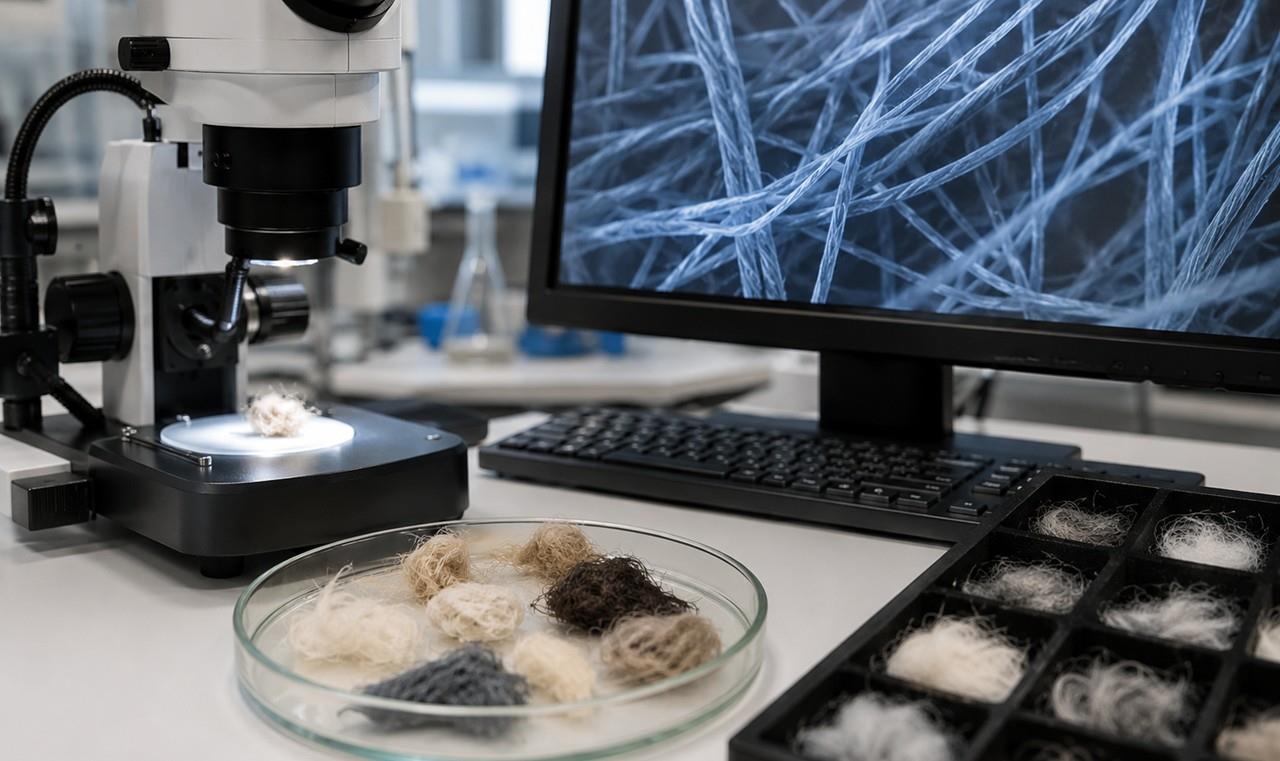
Textile fibres can be categorised into three main groups: natural fibres, artificial fibres, and synthetic fibres, depending on their origins and methods of production. Fibre identification is essential in ensuring quality control in the textile industry, monitoring exported products, accurate labelling of the goods, checking authenticity of the products, forensic examination, and recycling of the materials used. Conventional fibre identification procedures rely entirely on subjective observations and laboratory tests which may subject to human errors1.
The modern technological advancement and the emergence of complex blends as well as intelligent fibres have brought about the need for fast and intelligent fibre identification techniques. Artificial Intelligence is one such technique that has been developed to offer a solution in automatic fibre identification through computational learning methods. AI utilises the fibre images, spectra, and structural properties to train its models to detect the various types of fibres2,3.
Fundamentals of Textile Fibre Identification
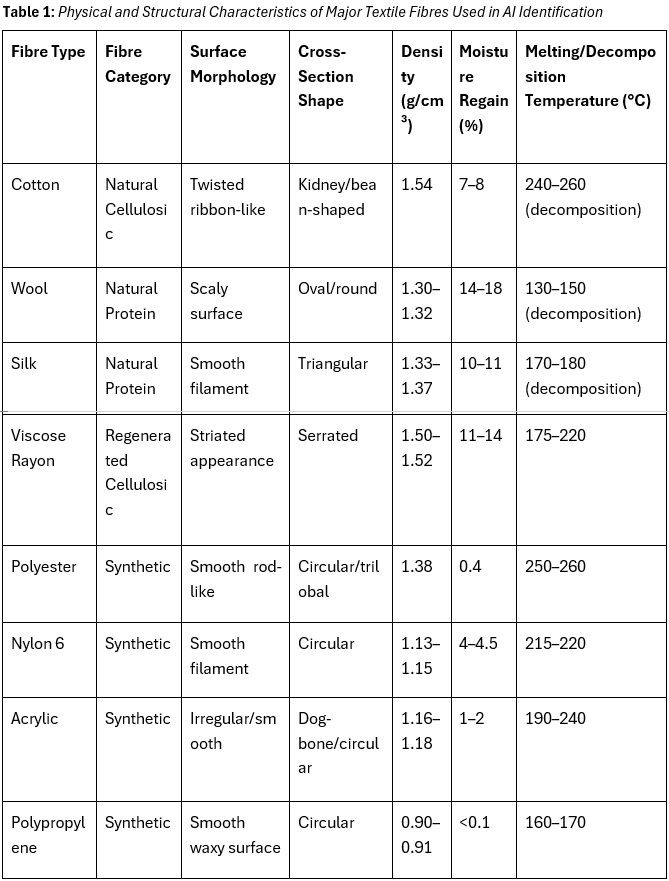
Fibre identification in textiles consists of identifying various physical, chemical, and structural properties of fibres. Every type of fibre has different properties like longitudinal features, cross-sectional profile, surface texture, density, crystallinity, infrared spectrum absorption, and thermal properties. AI-based systems use such properties as input features for classification purposes4,5.
In case of natural fibres like cotton, ribbons and twisted structures can be seen, in wool fibres, overlapping scales, and in silk fibres, smooth surfaces of filaments can be recognised. As for synthetic fibres such as polyester, nylon, or acrylic, geometrical profiles and smooth surfaces are identified. The algorithms recognise the unique properties of these fibres using image processing and pattern recognition.
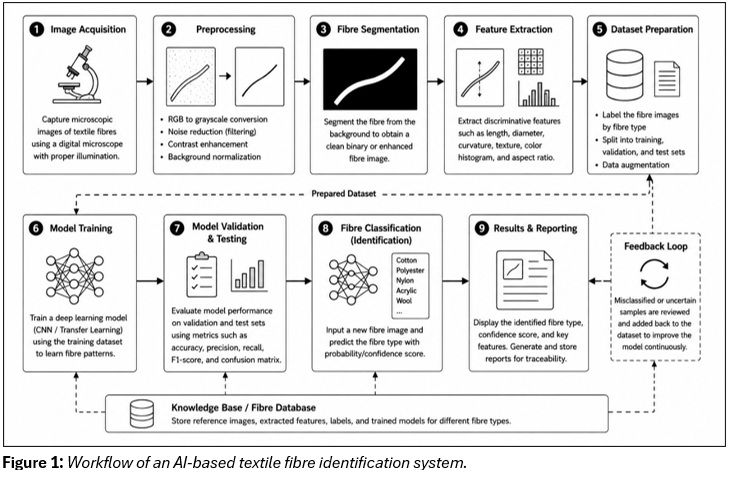
The main steps in AI-assisted fibre identification process include acquisition of images, pre-processing, feature extraction, model training, classification, and validation of results. A good dataset is crucial for enhancing prediction accuracy6.
The main textile fibres used for AI-based identification have distinctive properties.
Artificial Intelligence in Textile Fibre Identification
Artificial Intelligence refers to computational systems capable of simulating human intelligence for decision-making and pattern recognition. In textile fibre identification, AI algorithms learn from large datasets and classify fibres automatically based on trained patterns.
Machine Learning algorithms such as Support Vector Machine (SVM), Random Forest (RF), Decision Tree (DT), and K-Nearest Neighbor (KNN) are widely used for fibre classification. Deep Learning techniques, particularly Convolutional Neural Networks (CNNs), have gained significant importance due to their ability to automatically extract complex visual features from fibre images7,8.
The applications of AI technology include analysis of images and spectroscopy data taken through optical microscopes, hyperspectral images, and scanning electron microscopy (SEM). Such intelligent methods reduce the need for human expertise and enhance efficiency9.
A number of artificial intelligence and machine learning techniques have been developed for the purposes of identifying textile fibres.
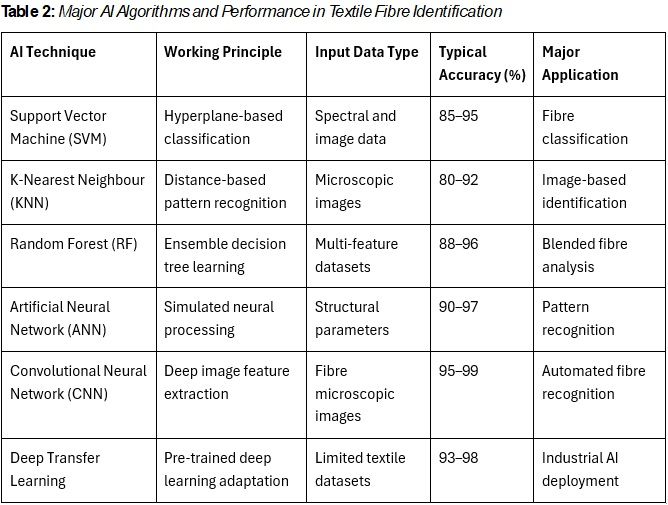
Image Processing Techniques in Fibre Identification
Image processing is one of the core technologies in AI-based textile fibre identification. Digital images captured through optical microscopes, SEM, or smartphone-based imaging systems are processed to enhance fibre visibility and extract structural information10.
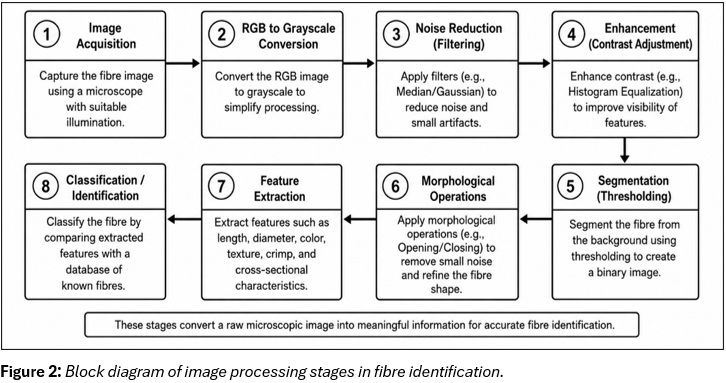 Preprocessing operations like converting images to grayscale, filtering noise, detecting edges, setting thresholds, and performing segmentation enhance image quality before any processing. Techniques for feature extraction determine the attributes of fibres like their diameter, surface finish, crimp pattern, shape, texture, and colour composition.
AI algorithms study these features and compare them to the trained dataset to classify the fibres properly. CNN architectures enable automatic learning of hierarchical features without human interference.
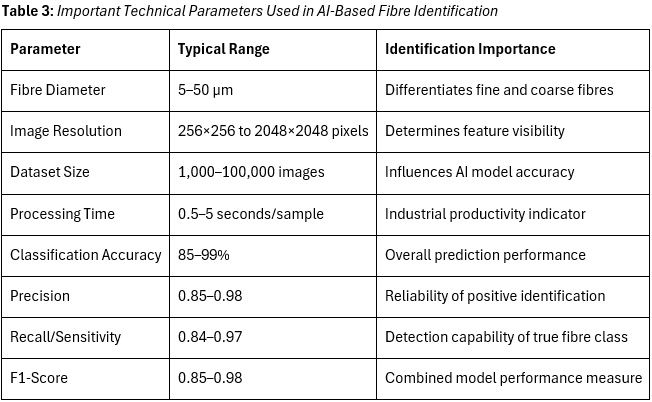
There are different parameters that are taken into account when analysing textile fibres using AI technology11.
Deep Learning Approaches for Fibre Classification
Deep Learning has brought about revolutionary changes in the field of fibre identification owing to its ability to recognise images accurately. Convolutional Neural Networks prove to be an effective choice as they can detect even small differences between fibres.
The architecture of CNN models includes convolution, pooling, activation function, and fully-connected layers. Popular architectures include ResNet, AlexNet, VGGNet, and EfficientNet that have found many applications in textile image classification12.
Deep Learning models are trained by using numerous fibre images tagged with their respective labels. While training, the deep learning model changes its internal parameters in order to improve its classification performance.
Transfer learning is another technique that has become popular in textile applications. Transfer learning involves modifying an existing image recognition model for fibre classification using fewer images13.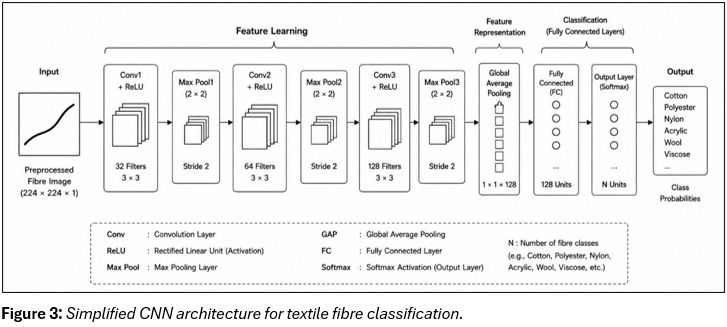
Spectroscopy-Based AI Fibre Identification
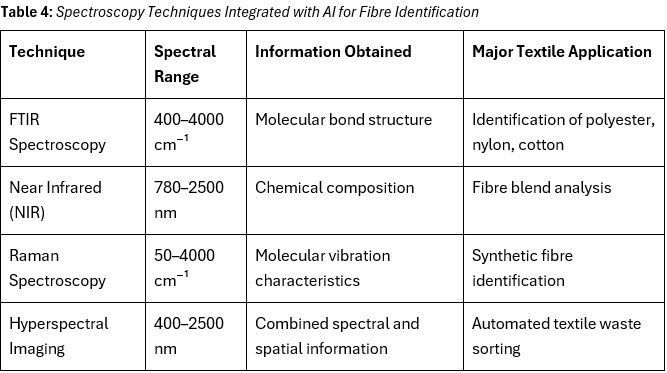
Fibre recognition using spectroscopy techniques along with AI yields extremely precise results. Some of the widely used spectroscopic techniques are Fourier Transform Infrared Spectroscopy (FTIR), Near-Infrared Spectroscopy (NIR), Raman Spectroscopy, and Hyperspectral Imaging14.
Such techniques yield spectral fingerprints that describe the chemical composition and molecular structure of fibres. AI processes such data to classify fibres quickly and without causing any damage to them.
FTIR spectroscopy along with machine learning (ML) has proven to be efficient in recognising polyester, nylon, cotton, viscose, and mixed fibres. Hyperspectral imaging coupled with AI helps to analyse textile material chemically and visually at the same time.
The use of AI and spectroscopy techniques in recycling of textiles is becoming highly significant.
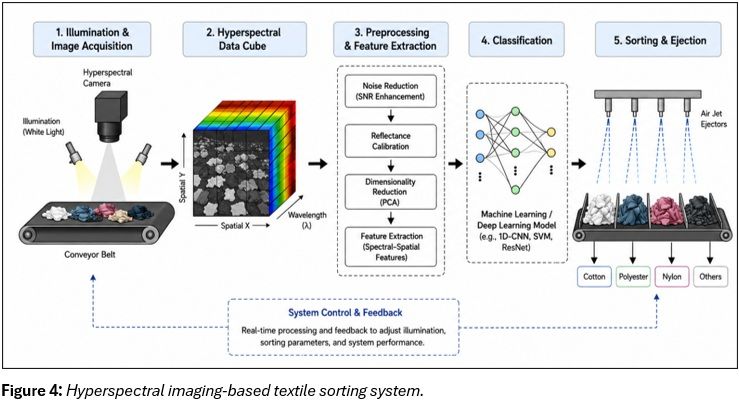 Advanced spectroscopy techniques integrated with AI systems provide rapid and non-destructive fibre identification through spectral analysis.
Applications of AI-Based Fibre Identification
AI-based fibre detection systems find wide applications in the textile and clothing industry. Spinning and weaving industries make use of AI-based systems that analyse the raw materials and their contamination. The application of AI in the clothing industry ensures the authenticity of fibre content in garments.
Fibre analysis using AI is applied in forensic investigations, where it is used for determining the source of fibres collected at crime scenes. Recycling firms in the textile industry make use of AI-based automatic sorting of fibres15.
AI-based systems are extensively used by luxury clothing brands to detect counterfeit textiles based on fibre structure and fabric composition. Advanced smart textile manufacturing firms implement AI-based inspection systems in their Industry 4.0 factories.
Researchers and academia make extensive use of AI for fibre analysis and experimental studies.
Advantages of AI in Textile Fibre Identification
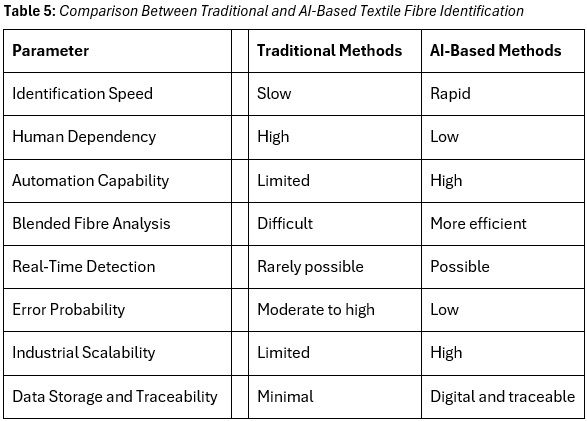
Fibre identification via AI has some notable benefits compared to manual approaches. The use of automatic algorithms is free from human errors and provides very consistent outcomes. Artificial intelligence allows for rapid scanning of many samples, which boosts productivity and cuts down expenses.
Deep learning algorithms can distinguish complex composite fibres and tiny structural discrepancies that cannot be observed by the human eye. There are no damages to the fabric structure during non-destructive analyses.
The possibility of real-time fibre identification enables smart production technologies and automated quality control. AI technology allows the development of a portable device for fibre identification using smartphones and cloud computing systems.
Nevertheless, there are some technical challenges that need to be addressed for AI-based fibre identification. First of all, the use of high-quality labelled datasets is crucial for successful model training. However, there is currently a shortage of textile fibre image databases. In addition, varying lighting conditions, levels of magnification, fibre preparation, and orientation can have an impact on the effectiveness of models.
Complex fibres are very challenging to recognise precisely because of their low proportion. Moreover, artificial intelligence models are quite resource-consuming; thus, small industries might face implementation difficulties. Another important issue concerns model generalisation. AI systems trained on small datasets will hardly function properly when dealing with different fibres.
AI and Sustainable Textile Recycling
Fibre identification using artificial intelligence for sustainable textile recycling is one of the most promising uses of AI. The rising trend in the production of textile wastes is necessitating the development of new technologies to sort such wastes efficiently.
The AI-enabled hyperspectral imaging process can enable automatic detection and segregation of cotton, polyester, wool, nylon, and mixed fibre types from textile waste streams. The use of such technology facilitates sustainable recycling processes in textiles production.
Such technological innovations make recycled fibre products cleaner, hence increasing their commercial value and enhancing the sustainability of the manufacturing process.
Industry 4.0 and Smart Textile Inspection
Fibre recognition using AI techniques is closely related to the emergence of Industry 4.0 innovations such as IoT, robotics, cloud computing, and cyber physical systems. In smart textile factories, AI-enabled inspection machines play an important role in identifying defects and fibres automatically.
AI-integrated systems that include robotic sampling, computer vision analysis, and AI classification can provide real-time monitoring of the textile production line. Cloud-based AI solutions support centralised quality control over several manufacturing facilities.
Digital twin techniques could possibly improve AI-based fibre monitoring systems in the future textile industry.
Future Trends in AI Fibre Identification
Multimodal AI technologies involving imaging, spectroscopy, and thermal measurements will be the future direction for achieving higher levels of precision. AI algorithms that can run effectively on lightweight portable devices will also become increasingly common.
Explainable AI (XAI) methods will play an important role to enhance the clarity of classification processes. Federated learning could make it possible to train AI algorithms within different textile industries without revealing confidential production information.
Generative AI algorithms may help generate datasets for less frequently observed fibres and increase the efficiency of algorithms. Integration of AI technology with nanotechnology and smart sensors could yield highly intelligent textile-testing equipment.



 marketing@alchempro.com